






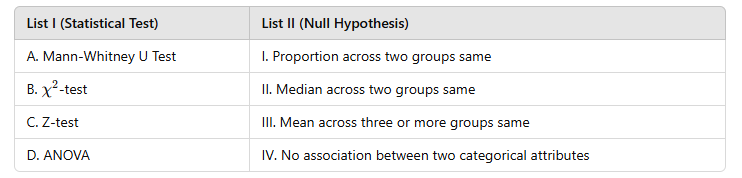
Correct option is B
·
Mann-Whitney U Test (A-II): This is a non-parametric test used to compare the
median of two independent groups. It does not assume normal distribution and is applied when data are ordinal or not normally distributed.
·
Chi-Square (χ2\chi^2χ2) Test (B-IV): The chi-square test evaluates whether there is
no association between two categorical variables. It compares observed and expected frequencies in contingency tables.
·
Z-test (C-I): This test is used for comparing
proportions between two groups when the sample size is large and follows a normal distribution.
·
ANOVA (D-III): ANOVA (Analysis of Variance) is a statistical method to compare the
means of three or more groups to determine if there are significant differences between them.
Information Booster: 1. Mann-Whitney U Test is also known as the Wilcoxon rank-sum test and is a non-parametric alternative to the t-test.
2. Chi-square test requires a sufficiently large sample size for accurate results. It is widely used in hypothesis testing for categorical data.
3. Z-test is applicable when population variances are known, often used for comparing sample and population proportions.
4. ANOVA extends the t-test to multiple groups and assumes homogeneity of variance.
5. For non-parametric data with more than two groups, the Kruskal-Wallis test serves as an alternative to ANOVA.
6. The choice of statistical test depends on data type (categorical, ordinal, interval) and distribution (normal or non-normal).
Additional Knowledge: · Mann-Whitney U Test (A-II): Used in cases where sample sizes are small or when data do not meet parametric assumptions. It tests whether two populations differ in their central tendencies.
· Chi-Square Test (B-IV): Applied in contingency tables, like testing independence between gender and voting preferences. A significant result implies the variables are not independent.
· Z-Test (C-I): Often used to compare two proportions, such as the success rate of two medical treatments. It assumes large sample sizes and follows the normal distribution.
· ANOVA (D-III): ANOVA uses the F-distribution to test hypotheses and requires assumptions like homogeneity of variance. Post-hoc tests like Tukey's test are used to determine pairwise differences when ANOVA shows significance.
Key Points: 1. Non-parametric tests (like Mann-Whitney) are robust to violations of normality.
2. Chi-square tests are limited to categorical data and do not measure strength or direction of association.
3. Z-tests assume a known population variance and are often replaced by t-tests when variances are unknown.
4. ANOVA requires normally distributed data within each group and equal variances.
 English
 10 Questions
 20 Marks
 12 Mins


