






Correct option is A
1.
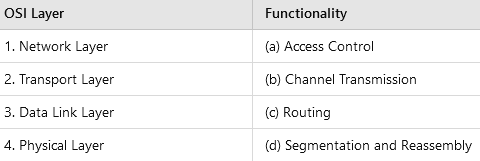
Network Layer → Routing (c):
· Responsible for logical addressing and determining the best path for data packets to reach their destination.
2.
Transport Layer → Segmentation and Reassembly (d):
· Handles data segmentation into smaller chunks for transmission and reassembly at the destination.
3.
Data Link Layer → Access Control (a):
· Provides frame synchronization, error checking, and regulates access to the shared medium.
4.
Physical Layer → Channel Transmission (b):
· Deals with the physical transmission of raw data bits over a communication medium.
Important Key Points:
1. The
OSI model consists of seven layers, with each layer handling a specific functionality for network communication.
2.
Network Layer: Routing, IP addressing.
3.
Transport Layer: Segmentation, reassembly, end-to-end delivery using TCP/UDP.
4.
Data Link Layer: Framing, error detection, MAC addressing.
5.
Physical Layer: Signal encoding, transmission over cables or wireless channels.
Knowledge Booster:
·
Routing (Network Layer): Determines the optimal path between source and destination.
·
Segmentation and Reassembly (Transport Layer): Ensures reliable data delivery.
·
Access Control (Data Link Layer): Regulates when devices can transmit on a shared medium (e.g., Ethernet).
·
Channel Transmission (Physical Layer): Transmits bits as electrical or optical signals.
 English
 100 Questions
 100 Marks
 60 Mins


