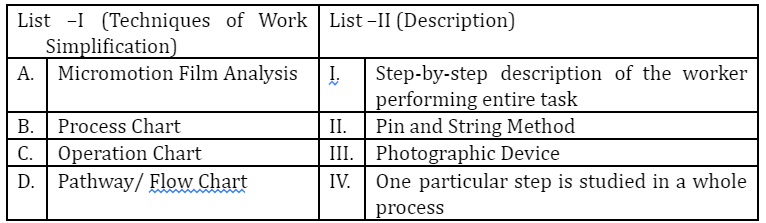
Correct option is B
Work Simplification Techniques are used to make work processes more efficient by reducing unnecessary movements, steps, or delays. These techniques help in analyzing, documenting, and improving workflows to increase productivity and reduce fatigue.
Micromotion Film Analysis (A-III):
Micromotion analysis uses photographic devices to capture minute details of worker motions. These recordings are analyzed to improve task efficiency by eliminating unnecessary movements. Thus, Micromotion Film Analysis matches with (III) Photographic Device.Process Chart (B-I):
The process chart gives a step-by-step description of the worker performing the entire task. It maps the entire process, showing activities like operations, inspections, and transportation, helping to identify bottlenecks. Therefore, Process Chart matches with (I) Step-by-step description of the worker performing the entire task.Operation Chart (C-IV):
The operation chart focuses on one particular step in a process. It provides details of that step in isolation, allowing deeper analysis and identification of potential improvements. Hence, Operation Chart matches with (IV) One particular step is studied in a whole process.Pathway/Flow Chart (D-II):
The pathway or flow chart illustrates the physical movement of workers or materials in the workspace. It is often created using the Pin and String Method, which helps optimize layout and reduce travel distances. Thus, Pathway/Flow Chart matches with (II) Pin and String Method.
Information Booster:
- Micromotion Film Analysis: Breaks down activities into micro-movements. Used for optimizing repetitive tasks and ensuring ergonomic efficiency.
- Process Chart: Offers a macro-level understanding of the entire workflow, helping to improve overall process performance.
- Operation Chart: Focuses on specific steps within a process to identify inefficiencies or delays.
- Pathway/Flow Chart: Provides a visual depiction of movements in a workspace to minimize unnecessary travel and improve productivity.
 English
 10 Questions
 20 Marks
 12 Mins