






Correct option is C
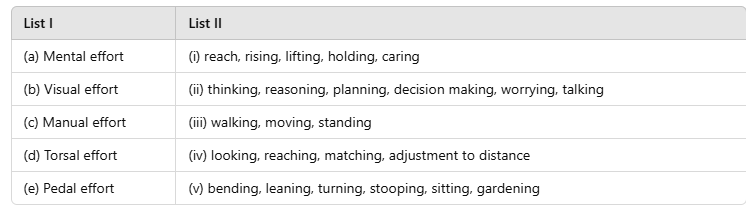
· (a) Mental effort (ii) thinking, reasoning, planning, decision making, worrying, talking: Mental effort refers to cognitive tasks that involve thinking, reasoning, and decision making.
· (b) Visual effort (iv) looking, reaching, matching, adjustment to distance: Visual effort involves actions such as looking, adjusting distances, or matching objects with your vision.
· (c) Manual effort (i) reach, rising, lifting, holding, caring: Manual effort involves physical actions that require use of hands or arms for tasks like lifting, holding, and reaching.
· (d) Torsal effort (v) bending, leaning, turning, stooping, sitting, gardening: Torsal effort includes actions like bending, turning, and stooping, which require torso movement.
· (e) Pedal effort (iii) walking, moving, standing: Pedal effort involves the lower body, particularly for tasks that include walking, standing, and moving.
Information Booster:
· Mental effort: The energy expended when engaging in cognitive processes such as problem-solving, concentration, or decision-making.
· Visual effort: This pertains to the physical and cognitive effort required for tasks that involve observing or interpreting visual stimuli.
· Manual effort: Associated with hand-eye coordination, lifting, or carrying objects.
· Torsal effort: This involves the torso (upper body) movement and requires balance and coordination.
· Pedal effort: It relates to the movement of legs for activities like walking and standing, involving coordination of lower limbs.
 English
 10 Questions
 20 Marks
 12 Mins


