
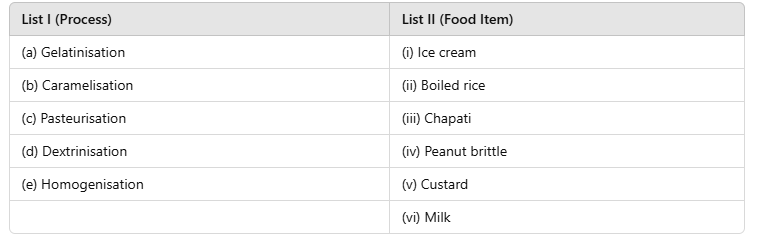
Correct option is D
1. (a) Gelatinisation – (ii) Boiled Rice:
· Gelatinisation is the swelling and thickening of starch granules when cooked in water. It is seen in boiled rice and pasta during cooking.
2. (b) Caramelisation – (iv) Peanut Brittle:
· Caramelisation refers to the browning of sugar upon heating. It is used in making peanut brittle, caramel custards, and confectionery.
3. (c) Pasteurisation – (vi) Milk:
· Pasteurisation is a process of heating milk at 72°C for 15 seconds and quickly cooling it to kill pathogens without altering taste.
4. (d) Dextrinisation – (iii) Chapati:
· Dextrinisation is the breakdown of starch into dextrins when starchy foods are dry heated (e.g., chapati, toast, roti), giving a brownish appearance.
5. (e) Homogenisation – (i) Ice cream:
Homogenisation is the process where fat droplets in milk or cream are broken down to create smooth ice cream.:
Information Booster:
· Gelatinisation: Temperature-dependent physical change in starch-based foods like rice, porridge, etc.
· Caramelisation: Non-enzymatic browning seen in high-sugar foods; adds flavor and color.
· Pasteurisation: Invented by Louis Pasteur; ensures microbial safety of milk and fruit juices.
· Dextrinisation: Increases digestibility and changes flavour and colour of dry-heated starch foods.
· Homogenisation: Milk fat breaking down to prevent cream from separating, important for ice cream.
 English
 10 Questions
 20 Marks
 12 Mins


