Correct option is A
Explanation:
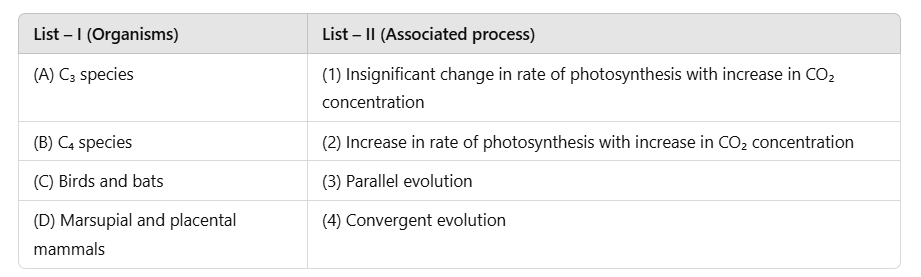
1. (A) C₃ species → (II) C₃ plants show a notable increase in photosynthetic rate with increased CO₂ concentration due to the suppression of photorespiration.
2. (B) C₄ species → (I) C₄ plants already concentrate CO₂ internally, so external increases in CO₂ have an insignificant effect on their photosynthesis rate.
3. (C) Birds and bats → (IV) Birds and bats evolved the ability to fly independently but share similar wing structures. This is convergent evolution (same function, different ancestry).
4. (D) Marsupial and placental mammals → (III) These two groups evolved similar adaptations independently (e.g., marsupial mole and placental mole), showing parallel evolution — similar development from related ancestors in different lineages.
Information Booster:
· Convergent evolution: Traits become similar in organisms from different ancestors, like wings in bats (mammals) and birds (avian).
· Parallel evolution: Similar traits develop independently in related species, like marsupial and placental mammals in similar ecological roles.
· C₃ vs. C₄ plants: C₃ are more CO₂-responsive, while C₄ plants are already efficient under high light and temperature and show minimal response to increased CO₂.
Additional Knowledge:
· Option 1: Incorrectly assigns C₃ species to (I) and birds/bats to (III), which is the reverse.
· Option 2: Correct for C₃ and C₄ species but reverses evolutionary processes for mammals and bats/birds.
· Option 3: Swaps birds and bats with the wrong evolution type.
· Option 4 is fully correct in both plant and evolutionary associations.
Explanation:
Let’s now correctly match each organism with the associated process:
· (A) C₃ species → (I) C₃ plants (like wheat and rice) show insignificant change in photosynthesis rate with increased CO₂ because photorespiration is already high, and Rubisco has low CO₂ affinity.
· (B) C₄ species → (II) C₄ plants (like maize and sugarcane) have a CO₂ concentrating mechanism, so they efficiently utilize CO₂ and can show an increase in photosynthesis when CO₂ increases.
· (C) Birds and bats → (IV) These unrelated animals evolved flight independently, which is a textbook example of convergent evolution.
· (D) Marsupial and placental mammals → (III) These evolved similar body forms (like flying squirrels in both groups) in parallel lineages, hence it's parallel evolution.
Information Booster:
· C₃ plants: High photorespiration, limited response to CO₂
· C₄ plants: Suppress photorespiration, show better CO₂ usage
· Convergent evolution: Similar traits in unrelated species (birds & bats)
· Parallel evolution: Similar traits in related lineages (marsupials & placentals)
Additional Information:
· Option (a), (b), and (c) mismatch the key evolutionary definitions or the physiological response to CO₂.
· Only option (d) gives the correct and scientifically accurate pairings.
 English
 10 Questions
 20 Marks
 12 Mins