Correct option is B
Introduction
Species interactions are a central concept in ecology. These interactions—such as parasitism, mutualism, commensalism, and competition—define how species coexist and impact each other's survival and fitness.
Information Booster:
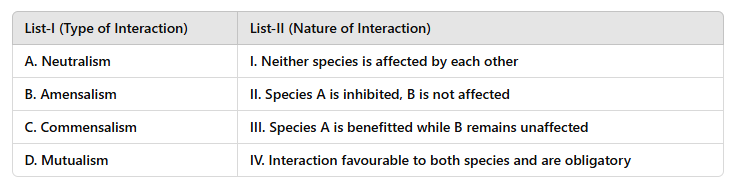
Based on ecological principles, here is the correct matching between the types of interaction (List-I) and their general nature (List-II):
(A) Parasitism Species A generally smaller than species B
In parasitism, the parasite (Species A) benefits at the expense of the host (Species B). Generally, parasites are much smaller than their hosts and do not immediately kill them.
(B) Mutualism Both species A and B positively affected in a positive and obligatory interaction
Mutualism is an interaction where both species benefit (+/+), and in many cases, it is obligatory for their survival.
(C) Commensalism Species A benefits while species B remains unaffected
- Commensalism is a (+/0) interaction where one species benefits and the other is neither helped nor harmed.
(D) Competition Both species A and B negatively affected in the interaction
- Competition is a (-/-) interaction because both species must contend for the same limited resources, which reduces the fitness of both.
 English
 10 Questions
 20 Marks
 12 Mins