Correct option is D
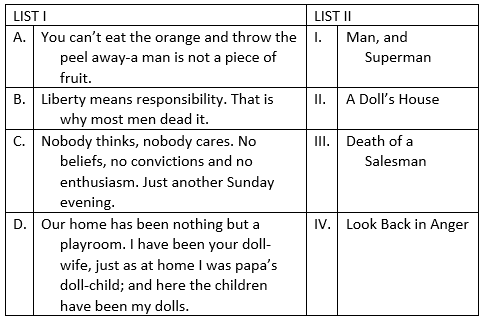
1.You can’t eat the orange and throw the peel away-a man is not a piece of fruit.
The lines are from Arthur Miller's play "Death of a Salesman." They are spoken by the character Willy Loman in Act 2 of the play.
In this poignant metaphor, Willy is expressing his deep sense of dissatisfaction and frustration with his own life and the American Dream.
The metaphor of eating an orange and throwing away the peel suggests a sense of waste and emptiness. Willy feels that he has spent his life striving for success and material wealth but has not found true happiness or fulfilment. He believes that people should not be treated as disposable commodities, as if their value is only in what they can produce or achieve.
"Death of a Salesman" is a powerful exploration of the American Dream and its disillusionment. Willy Loman, the central character, grapples with the idea that success is not solely defined by financial gain but also by personal happiness and meaningful relationships. These lines capture the emotional depth and complexity of Willy's character and his realization that there is more to life than the pursuit of material success.
2.Liberty means responsibility. That is why most men dead it
The line provided is from George Bernard Shaw's play "Man and Superman."
It is spoken by the character John Tanner in Act 3, during a philosophical dialogue. In this line, Tanner is expressing a provocative idea about liberty and responsibility.
The quote suggests that true liberty is not just about freedom but also entails a sense of responsibility. Many people are drawn to the idea of freedom but may shy away from the responsibilities that come with it. The quote implies that embracing true liberty requires individuals to accept and act upon their responsibilities, and this can be challenging for many.
"Man and Superman" is a play that explores various philosophical and social themes, and this quote is reflective of Shaw's own views on society and individualism. It highlights the complex relationship between freedom and responsibility, a theme that runs throughout the play.
3.Nobody thinks, nobody cares. No beliefs, no convictions and no enthusiasm. Just another Sunday evening
The lines are from John Osborne's play "Look Back in Anger." They are spoken by the character Jimmy Porter, who is known for his disillusionment and anger towards the world around him. In these lines, Jimmy is expressing a sense of apathy and despair about the state of society and the people around him.
He believes that people have become passive and disengaged, lacking strong beliefs, convictions, or enthusiasm. The reference to "Just another Sunday evening" suggests a mundane and uneventful existence, which adds to Jimmy's frustration.
"Look Back in Anger" is a play that is often associated with the "angry young man" movement in British drama during the mid-20th century. Jimmy Porter, the central character, embodies the anger and discontent of a generation that felt disillusioned with the post-war social and political landscape. These lines capture the sense of alienation and disconnection that Jimmy feels from the society he perceives as stagnant and indifferent.
4.Our home has been nothing but a playroom. I have been your doll-wife, just as at home I was papa’s doll-child; and here the children have been my dolls.
These lines are from Henrik Ibsen's play "A Doll's House." They are spoken by the character Nora Helmer in Act 3 of the play.
In these lines, Nora reflects on her role in her marriage and the way she has been treated as a "doll-wife" by her husband Torvald.
Nora's statement highlights the theme of gender roles and societal expectations in the play. She has been living a life where she feels like she's merely a plaything in her husband's world, expected to fulfill the roles of a wife and mother without any real agency or independence.
The metaphor of being a "doll-wife" and her children being her "dolls" underscores the idea of her lack of autonomy and individuality in her marriage. As the play progresses, Nora's character undergoes a transformation, and she begins to question her role and assert her independence. These lines mark a significant moment in her realization of the oppressive nature of her marriage and her desire for something more meaningful and fulfilling in her life.
 English
 10 Questions
 20 Marks
 12 Mins