






Correct option is B
Explanation:
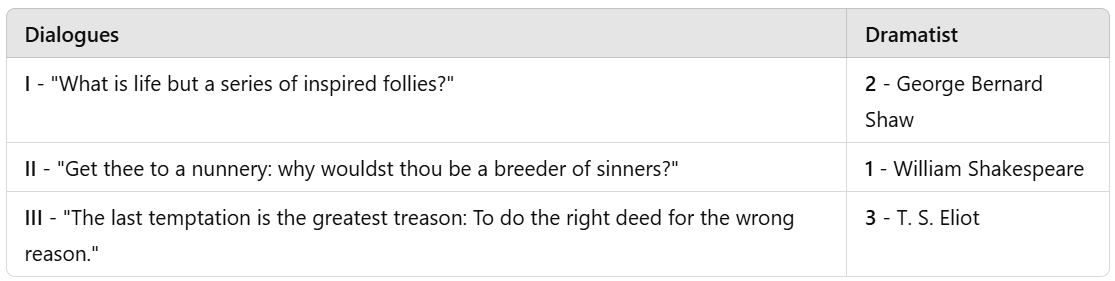
I - George Bernard Shaw
The line "What is life but a series of inspired follies?" is from Shaw’s play Pygmalion (1913). This play, which inspired My Fair Lady, is a social satire on class distinctions and education.
II - William Shakespeare
The famous line "Get thee to a nunnery: why wouldst thou be a breeder of sinners?" is spoken by Hamlet in Hamlet (Act 3, Scene 1). This is part of Hamlet’s confrontation with Ophelia, where he expresses his disillusionment with women and humanity.
III - T. S. Eliot
The quote "The last temptation is the greatest treason: To do the right deed for the wrong reason." comes from Eliot’s Murder in the Cathedral (1935), a play about the assassination of Archbishop Thomas Becket. It explores themes of faith, power, and moral dilemmas.
Information Booster:
George Bernard Shaw (1856–1950) – An Irish playwright and critic known for his witty social critiques, including Pygmalion, Saint Joan, and Man and Superman.
William Shakespeare (1564–1616) – The greatest English playwright, famous for Hamlet, Macbeth, King Lear, Othello, and many other works.
T. S. Eliot (1888–1965) – A modernist poet and dramatist known for The Waste Land, Four Quartets, and the verse drama Murder in the Cathedral.
Pygmalion and Social Commentary – Shaw’s Pygmalion critiques class inequality and the superficiality of social transformation through speech and manners. In Shaw's ingenious adaption, linguistic specialist Professor Henry Higgins bets that he can turn a clumsy cockney flower vendor into a sophisticated young woman by only improving her manners and altering her speech patterns. The Professor falls in love with his exquisite handiwork while persuading society that his invention is a mystery royal person.
Pygmalion is one of the most well-known comedies in the English language because of its captivating theme of the butterfly's emergence, as well as Shaw's masterful dialogue and outstanding playwriting abilities. It is still often performed and is a mainstay of college drama classes.
Hamlet and Existential Crisis – Hamlet deals with themes of madness, betrayal, and the philosophical question of existence. It is Shakespeare's longest play. Set in Denmark, the play depicts Prince Hamlet and his attempts to exact revenge against his uncle, Claudius, who has murdered Hamlet's father in order to seize his throne and marry Hamlet's mother. Hamlet is considered among the "most powerful and influential tragedies in the English language", with a story capable of "seemingly endless retelling and adaptation by others". It is widely considered one of the greatest plays of all time. Three different early versions of the play are extant: the First Quarto (Q1, 1603); the Second Quarto (Q2, 1604); and the First Folio (F1, 1623). Each version includes lines and passages missing from the others.
Murder in the Cathedral and Martyrdom – Eliot’s play examines the tension between political power and religious faith, dramatizing Becket’s moral struggle. It is a verse drama by T. S. Eliot, first performed in 1935 (published the same year). The play portrays the assassination of Archbishop Thomas Becket in Canterbury Cathedral during the reign of Henry II in 1170. Eliot drew heavily on the writing of Edward Grim, a clerk who was an eyewitness to the event
 English
 150 Questions
 150 Marks
 150 Mins



