Correct option is B
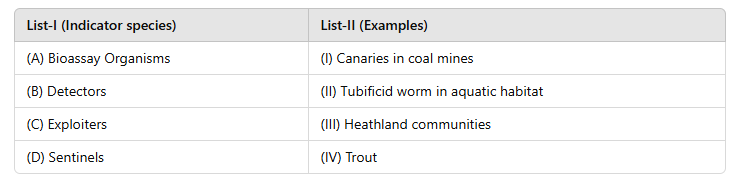
1. Bioassay Organisms (A) → (IV):
· Trout are used in bioassays to test water quality and the impact of pollutants on aquatic life.
2. Detectors (B) → (II):
· Tubificid worms are indicators of water pollution, particularly in habitats with high organic matter, serving as detectors of low oxygen conditions.
3. Exploiters (C) → (III):
· Heathland communities are known for exploitative adaptations, thriving in nutrient-poor soils by utilizing resources efficiently.
4. Sentinels (D) → (I):
· Canaries were historically used in coal mines as sentinels to detect harmful gases such as carbon monoxide.
Thus, the correct matching is (A)-(IV), (B)-(II), (C)-(III), (D)-(I), making the correct answer Option 2.
Information Booster: 1. Indicator Species and Their Roles:
· Bioassay Organisms: Used to assess environmental quality through controlled experiments.
· Detectors: Indicate specific environmental changes or pollution.
· Exploiters: Species adapted to use available resources efficiently, often in challenging environments.
· Sentinels: Early-warning indicators of environmental hazards.
2. Applications:
· Environmental monitoring.
· Pollution detection.
· Ecosystem health assessment.
Additional Knowledge: Bioassay Organisms (A):
· Example: Trout in water quality testing.
· Purpose: Used to measure the effects of environmental pollutants.
Detectors (B):
· Example: Tubificid worms.
· Purpose: Reflect poor water quality and oxygen depletion.
Exploiters (C):
· Example: Heathland species.
· Purpose: Thrive in resource-limited conditions.
Sentinels (D):
· Example: Canaries in coal mines.
· Purpose: Provide early warning for hazardous gases.
 English
 10 Questions
 20 Marks
 12 Mins