Correct option is D
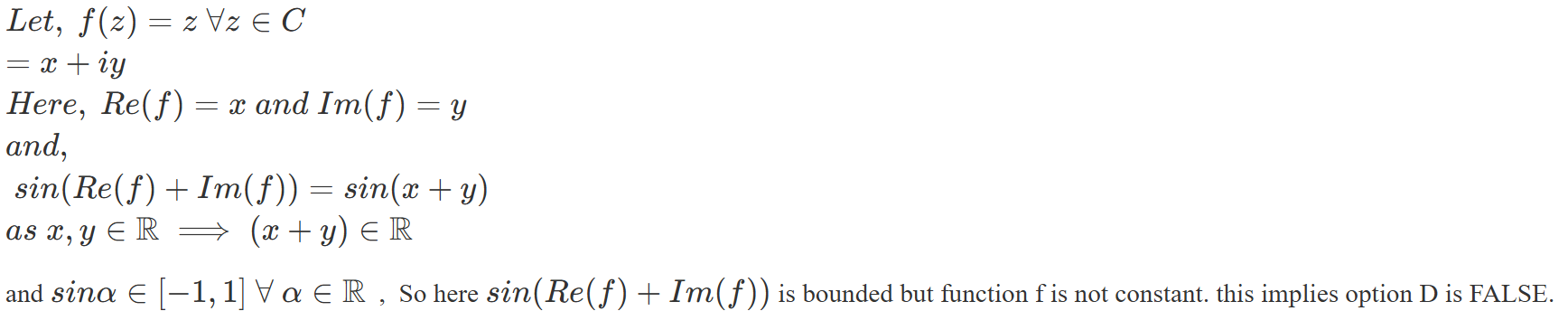







Let f be an entire function . Which of the following statements is FALSE ?




Let Y={1,2,3,…,100} and let h:Y→Y be a strictly increasing function. The total number of functions g:Y→Y satisfying g(h(j))=h(g(j)) for all j∈Y are ?
Let f be a holomorphic function on the disc
Assume that the only zero of f in the closed unit disc
is a simple zero at the origin. Let be the positively oriented circle
The integral equals ?
Sum of the infinite series
is equal to ?
A function f: ℂ → ℂ is said to be analytic at ∞, if the function g defined by
g(w) = f () is analytic at 0 with an appropriate value given for g(0).
Which of the following statements is true?
If | | = 1 for a complex number z = x + iy, x, y ∈ R,then.
which of thefollowing is true ?
Let f be a non-constant entire function such that |f(z)| = 1 for |z| = 1.
Let U denote the open unit disk around 0.
Which of the following is FALSE ?


