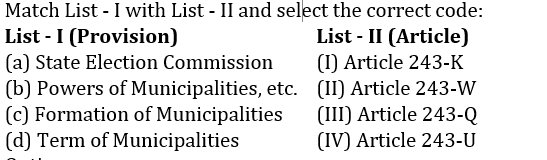
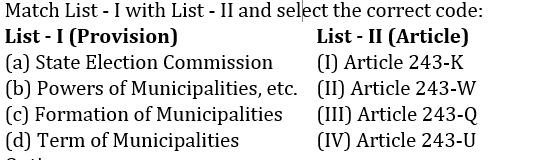
Correct option is A
In the event of the dissolution of a Panchayat before the completion of its five-year term, the newly constituted Panchayat shall serve for the remaining period of the original term, rather than a fresh five-year term. This provision ensures continuity in the local governance process without unnecessarily prolonging or shortening the election cycle. The constitutionally prescribed term of a Panchayat is five years, and a new Panchayat formed after dissolution is expected to serve only for the remaining duration of that term.
This rule is in line with Article 243E of the Indian Constitution, which governs the tenure of Panchayats.
Information Booster:
1. Article 243E: Deals with the tenure of Panchayats, stating that every Panchayat shall have a five-year term, but if dissolved early, the new Panchayat serves the remaining term.
2. Dissolution: If a Panchayat is dissolved before its full term, elections must be held within six months to constitute a new Panchayat.
3. Five-year tenure: Panchayats are elected for a fixed term of five years under normal circumstances.
4. Panchayati Raj: This system of local self-governance is integral to decentralized governance in India, providing administrative powers at the village level.
5. Continuity of Governance: Ensures that local administration continues smoothly even in the event of dissolution.
 English
 10 Questions
 20 Marks
 12 Mins