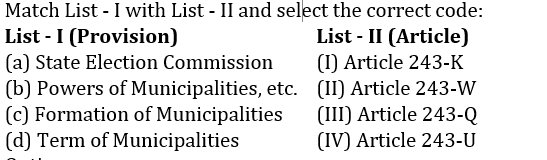
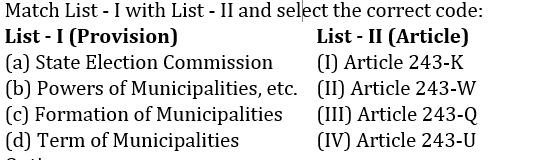
Correct option is C
The correct answer is (c) Urban Local Bodies Administration. The Seventy-Fourth Constitutional Amendment Act of 1992 focuses on the administration and governance of urban local bodies in India. It brought significant reforms to the structure and functioning of urban local governance by providing constitutional recognition to urban local bodies like Municipalities and Nagar Panchayats. The Act aimed at empowering urban local governments by ensuring their autonomy, participation in decision-making, and improving service delivery in urban areas. It also provided for the establishment of State Finance Commissions and ensured regular elections to local bodies.
The Act ensures that urban areas, which have different governance needs from rural areas, are properly managed with adequate powers and responsibilities to local governing bodies.
Information Booster:
The 74th Constitutional Amendment Act of 1992 is a landmark legislation aimed at strengthening Urban Local Bodies (ULBs) in India. The amendment introduced significant reforms to the structure, powers, and functions of local self-governments in urban areas, providing them with constitutional recognition and empowering them for more efficient governance. It is also seen as a major step towards decentralizing urban governance.
Key Features of the 74th Amendment:
Constitutional Status to Urban Local Bodies:
The amendment gave constitutional recognition to urban local bodies, making it mandatory for states to establish Municipalities (Municipal Corporations, Municipalities, and Nagar Panchayats) in urban areas.
Three-Tier Structure:
The amendment defines a three-tier structure for urban governance:
Municipalities for areas with a population of under one million.
Municipal Corporations for areas with a population of over one million.
Nagar Panchayats for smaller urban areas transitioning from rural to urban.
Urban Local Body Elections:
The amendment mandates regular elections to urban local bodies every five years.
The state governments are responsible for ensuring that the elections are free, fair, and conducted within the specified time period.
Mayor and Councilor’s Powers:
The amendment provides for the direct election of the Mayor (in Municipalities and Municipal Corporations) and ensures that the Mayor and other elected representatives have more power and autonomy in decision-making.
The Councilors are given greater responsibility for managing the local governance and implementing policies.
Powers and Functions:
The amendment enables urban local bodies to have greater authority in matters related to local governance, including urban planning, water supply, sanitation, and health care.
It provides urban local bodies with financial autonomy and access to funds through the establishment of the State Finance Commission.
State Finance Commissions:
A provision was made to ensure financial devolution to urban local bodies by constituting a State Finance Commission that would recommend the distribution of financial resources between the state and urban local bodies.
District Planning Committee:
The amendment introduced the provision of District Planning Committees (DPC) for better coordination of planning activities at the urban level.
Reservation of Seats:
It mandates the reservation of seats for Scheduled Castes, Scheduled Tribes, and women, ensuring their participation in local governance.
Functions and Responsibilities of Local Bodies:
The amendment also outlines the functions of urban local bodies, such as urban planning, regulation of land use, planning for economic and social development, and welfare of weaker sections.
Empowerment of Municipalities:
The amendment emphasized the empowerment of Municipalities and encouraged their participation in urban development projects, thus playing a key role in urban development and governance.
 English
 10 Questions
 20 Marks
 12 Mins