Correct option is A
Explanation-
RFLP is used here to distinguish alleles of the R gene (Starch Branching Enzyme).
Round seeds: Functional R gene (no insertion).
Wrinkled seeds: Transposon insertion disrupts R gene → larger DNA fragment due to insertion.
Probe: cDNA of R gene → binds only to fragments containing the R gene or its disrupted version.
Lane Analysis:
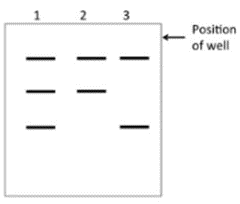
From the gel image:
Lane 1: One band (upper position) — longer fragment.
Lane 2: Two bands — one at upper position (like lane 1), one at lower position (like lane 3).
Lane 3: One band (lower position) — shorter fragment.
Interpretation:
Lane 1: Homozygous round (R/R) — no insertion → shorter fragment.
Lane 3: Homozygous wrinkled (r/r) — insertion present → longer fragment.
Lane 2: Heterozygous (R/r) — shows both bands.
This implies:
Lane 1 = Round (R/R)
Lane 2 = Heterozygous (R/r)
Lane 3 = Wrinkled (r/r)
Analyzing each Option:
Option a - Lane 3 represents genomic DNA from plant with wrinkled seeds.
Lane 3 has the smaller fragment, hence round; this is the wrong statement.
Option b - These DNA markers are co-dominant in nature.
Correct — both alleles visible in heterozygote (lane 2 shows both bands).
Option c - Lane 1 represents genomic DNA from plant with round seeds.
Correct — small fragment, no insertion, R/R.
Option d - If genomic DNA from F₂ progeny (Mendel) was analyzed by RFLP, the ratio of patterns in lanes 1, 2, and 3 will be 1:2:1.
Correct — classical Mendelian segregation.
Final Answer: Option a is incorrect statement that makes it a correct answer.