Correct option is B
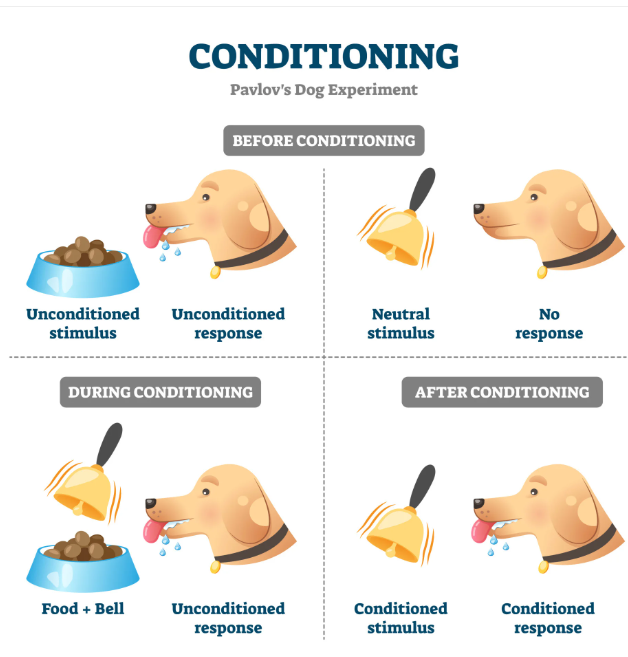
This is an example of classical conditioning. In this type of learning, an organism learns to associate a neutral stimulus (the bell) with a stimulus that naturally produces a response (the food, which causes salivation). After repeated pairings, the neutral stimulus (bell) alone triggers the same response (salivation) as the unconditioned stimulus (food). Pavlov's experiments demonstrated this principle.
Information Booster:
- Classical conditioning involves learning by association, where a neutral stimulus becomes associated with a stimulus that naturally produces a response.
- Unconditioned stimulus (US) is a stimulus that automatically triggers a response, like food causing salivation in Pavlov's experiment.
- Conditioned stimulus (CS) is initially a neutral stimulus, like the bell, which, after being paired with the unconditioned stimulus, starts eliciting the response.
- Conditioned response (CR) is the learned response to the conditioned stimulus, such as the dog salivating at the sound of the bell.
Additional Information:
- Operant conditioning (a): This type of learning involves behavior that is influenced by consequences, such as rewards or punishments. Unlike classical conditioning, it doesn't involve the association of a neutral stimulus with an unconditioned stimulus.
- Sensitization (c): This refers to an increased response to a repeated stimulus, which typically occurs after exposure to a strong or noxious stimulus. It is not the same as classical conditioning.
- Habituation (d): This is the decrease in response to a repeated stimulus over time. It is the opposite of sensitization and is not related to the association of two stimuli as in classical conditioning.