Correct option is B
The correct answer is: (B) By simple diffusion
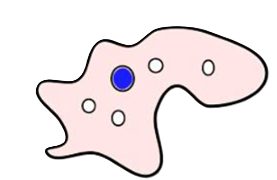
Many simple organisms, such as unicellular organisms (e.g., amoeba, paramecium, etc.), get rid of their nitrogenous wastes through simple diffusion. In these organisms:
- Waste products, including nitrogenous wastes like ammonia, are removed directly across the cell membrane.
- This process is passive and relies on a concentration gradient (higher concentration of waste inside the organism than outside).
- Since they live in aquatic environments, diffusion is an efficient mechanism for waste removal.
Information booster:
Option | Explanation |
(A) Through excretory vacuoles | Excretory vacuoles are present in organisms like protozoans (e.g., paramecium, amoeba) and are primarily used for osmoregulation, i.e., maintaining water balance by expelling excess water from the cell. However, they do not play a role in excreting nitrogenous wastes. |
(C) By secretion | Secretion involves the production and release of substances like hormones, enzymes, or waste products through specialized structures or cells. This process is not observed in simple unicellular organisms for nitrogenous waste excretion. It is typical in more complex organisms with specialized systems. |
(D) By depositing crystals in vacuoles | Some multicellular organisms, like insects, use this method. They convert nitrogenous wastes (e.g., uric acid) into insoluble crystals, which are stored temporarily in vacuoles and later excreted. This method is part of uricotelic excretion, not observed in unicellular organisms. |
Key Points:
Simple Diffusion:
- Nitrogenous wastes like ammonia are highly soluble in water and diffuse out of the organism into the surrounding water.
- There is no specialized excretory organ or structure in such simple organisms.
Why Diffusion Works:
- Small size and large surface area-to-volume ratio make diffusion sufficient for excretion.
- Aquatic surroundings ensure constant removal of waste.
 English
 100 Questions
 100 Marks
 90 Mins