






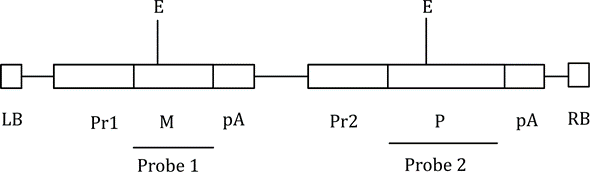
Correct option is D
Detailed Explanation:
(a) Single copy events from the LB flank identified using Probe 1 would show two hybridization bands:
This is correct because Probe 1 is near the LB border and can hybridize to two fragments after digestion with restriction enzyme E. One band corresponds to the fragment between the LB and the nearest E site within the T-DNA, and the other band corresponds to the fragment between the LB and an E site in the genomic DNA flanking the insertion. This results in two hybridization bands, confirming (a) as true.(c) For true single copy events, one hybridization band would be of the same length for each of the two probes used for hybridization:
For a single copy insertion, although the bands are detected by two different probes at LB and RB flanks, the band representing the entire T-DNA region (between LB and RB borders) will be common, so one band size should be the same in both probes because the T-DNA length is fixed. The other bands vary due to flanking genomic DNA. This makes (c) correct.(d) True single copy events would show two bands each for copy number on the left border and right border flanks:
The LB border flank probe typically shows two bands as explained above. Similarly, Probe 2 near the RB border flank can also show two bands, one from T-DNA internal fragment and one from genomic DNA flanking region. Hence, for true single copy insertions, two bands each from LB and RB flanks are possible, making (d) correct.(b) Single copy events from the RB flank identified using Probe 2 would show a single hybridization band:
This is generally incorrect because, as discussed, Probe 2 can detect two bands (one from the internal T-DNA fragment and one from the flanking genomic DNA). So, (b) is not true in all cases.
Summary:
(a) is true — two bands from LB flank with Probe 1.
(c) is true — one band size common to both probes corresponding to the T-DNA region.
(d) is true — two bands can appear from each border flank in single copy events.
(b) is false — single band from RB flank probe is not always the case.


