






Correct option is C
Explanation-
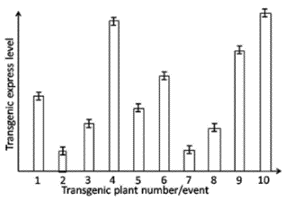
Statement A: "Plant nos. 4, 9 and 10 that show high expression levels of the transgene would necessarily contain multiple copies of the transgene." - INCORRECT
High transgene expression does not necessarily mean multiple copies. Even a single-copy insertion can show high expression if the transgene lands near a strong enhancer or in a transcriptionally active genomic region (position effect). Similarly, multi-copy insertions can sometimes undergo gene silencing and show low expression. High expression could happen even with a single copy depending on insertion site.
Statement B: "Plant nos. 2 and 7 contain mutations in the coding sequence of the transgene in the construct." - INCORRECT
Low expression in plants 2 and 7 is more likely due to poor genomic integration sites (position effects), gene silencing, or epigenetic effects, not necessarily coding sequence mutations. Also, mutations in coding sequence would likely affect protein function/translation, not just expression level.
Statement C: "The transgenic plants may contain varying number of transgene copies inserted at different locations in the host genome." - CORRECT
True and common in Agrobacterium-mediated transformation. Each independent event usually inserts the transgene at a random genomic location, with varying copy numbers. Both copy number and insertion site (position effect) cause variability in expression among independent transgenic lines.
Statement D: "The host genome has no role in influencing expression levels of the transgene." - INCORRECT
Position effects from the host genome (e.g., heterochromatin vs euchromatin, promoter-enhancer proximity, silencing regions) directly influence transgene expression. In fact, host genome context is one of the biggest factors affecting transgene expression.
Statement E: "The stability of the transgenic mRNA and its translatability would not be different among the independent transgenic plants." - CORRECT
Since the transgene construct is the same in all plants, and the coding sequence is the same,
mRNA stability and translation efficiency should theoretically remain constant across plants (unless affected by positional effects or silencing, which typically act at transcriptional level, not at mRNA stability).
Final Correct Answer: C and E only (Option c)


