






Correct option is A
The correct answer is (a) Both Statement I and Statement II are true.
1. Statement I:
· True. Natural gas primarily consists of methane (CH₄), making up about 60–90% of its composition. It also contains other hydrocarbons such as ethane (C₂H₆), propane (C₃H₈), and butane (C₄H₁₀) in smaller amounts.
2. Statement II:
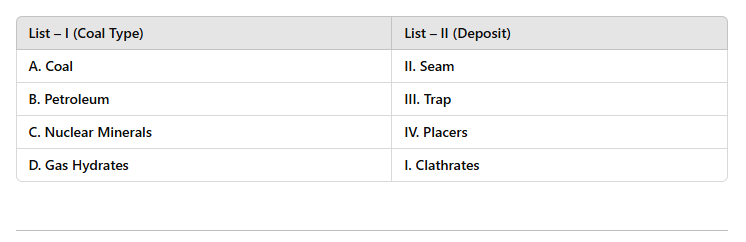
· True. Large amounts of natural gas are trapped in the form of methane hydrates (clathrates) in ocean sediments and permafrost regions. Methane hydrates are ice-like structures where methane molecules are trapped within a lattice of water molecules.
Information Booster 1. Natural Gas Composition:
· Methane (CH₄): 60–90%
· Ethane (C₂H₆), Propane (C₃H₈), Butane (C₄H₁₀): Minor components
· Other Gases: Small quantities of carbon dioxide (CO₂), nitrogen (N₂), and hydrogen sulfide (H₂S)
2. Methane Hydrates (Clathrates):
· Found in deep-sea sediments and permafrost regions.
· Considered a potential future energy source due to their vast reserves.
· Methane hydrates are stable under conditions of high pressure and low temperature.
3. Significance of Methane Hydrates:
· Potential to meet global energy demands.
· Extraction challenges due to stability issues and environmental concerns.
4. Uses of Natural Gas:
· Electricity generation, heating, cooking, and as a fuel for vehicles.
· Cleaner alternative to other fossil fuels like coal and oil.
Additional Knowledge · Formation of Methane Hydrates:
· Formed when methane produced by microbial decomposition of organic matter is trapped in water molecules under high-pressure, low-temperature conditions.
· Environmental Impact:
· Methane is a potent greenhouse gas. The release of methane from hydrates due to global warming could accelerate climate change.
 English
 10 Questions
 20 Marks
 12 Mins
 Choose the correct answer:



