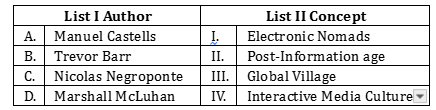
Correct option is C
Statement I: "In symbolic communication, power operates through images."
True. Symbolic communication involves conveying meaning through symbols, signs, and images. Power can be exercised symbolically by shaping perceptions, ideologies, and emotions through visual media and cultural symbols (e.g., flags, logos, political imagery).
Statement II: "Such an advantage of exercising power does not exist in other types of communication."
False. Power can be exercised in all forms of communication—verbal, written, non-verbal, digital, etc.—not just symbolic. For example, political speeches, media framing, and persuasive writing also convey power.
So, only Statement I is true.
True. Symbolic communication involves conveying meaning through symbols, signs, and images. Power can be exercised symbolically by shaping perceptions, ideologies, and emotions through visual media and cultural symbols (e.g., flags, logos, political imagery).
Statement II: "Such an advantage of exercising power does not exist in other types of communication."
False. Power can be exercised in all forms of communication—verbal, written, non-verbal, digital, etc.—not just symbolic. For example, political speeches, media framing, and persuasive writing also convey power.
So, only Statement I is true.
The correct answer is (c) Statement I is true but Statement II is false.
 English
 10 Questions
 20 Marks
 12 Mins