Correct option is C
Animal development involves cell fate determination, cleavage patterns, and gastrulation movements, which vary among species. Let’s analyze each statement carefully.
Analysis of the Statements:
Statement A: Correct
- The statement describes cell specification, which is an early stage of cell fate determination.
- Specification means that a cell has a predetermined fate but can still be influenced by external factors.
- In autonomous specification, a cell develops according to its original fate even when isolated (e.g., tunicates).
- In conditional specification, cell fate is influenced by interactions with neighboring cells (e.g., sea urchins).
- Since the statement accurately describes specification, it is correct.
Statement B: Incorrect
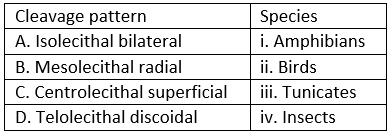
- Holoblastic rotational cleavage occurs in mammals and nematodes (C. elegans), not tunicates.
- Tunicates exhibit bilateral cleavage, where the first cleavage plane aligns with the body symmetry.
- Since tunicates do not show rotational cleavage, this statement is incorrect.
Statement C: Incorrect
- Ingression is a type of gastrulation movement where individual cells migrate into the embryo.
- The statement incorrectly defines ingression as "infolding of a sheet of cells," which actually describes invagination.
- Since ingression does not involve sheet folding, this statement is incorrect.
Statement D: Correct
- Conditional specification is observed in sea urchin embryos.
- In this type of specification, cell fate is determined by interactions between cells rather than intrinsic factors.
- If a blastomere is removed from an early sea urchin embryo, it can still develop into a full organism, demonstrating regulative development.
- This statement is correct.
Final Selection:
Since A and D are correct, the correct answer is:
Option 3 (A and D).