Correct option is C
Explanation-
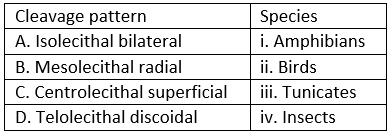
Cleavage is the series of rapid mitotic cell divisions of the zygote immediately following fertilization. These divisions increase the number of cells (called blastomeres), do not increase the total volume of the embryo, ultimately form a blastula. In mammals, cleavage is holoblastic (complete), asynchronous and rotational.
The first cleavage is meridional (divides top to bottom). The second cleavage is one meridional and one equatorial, giving rise to a rotational cleavage pattern.
Incorrect Options -
Option a - Radial : Seen in deuterostomes like echinoderms, not mammals.
Option b - Spiral : Seen in protostomes like annelids and mollusks.
Option d - Bilateral : Observed in tunicates and some other organisms, not typical of mammals.
Final Answer:
Option c - Rotational cleavage