






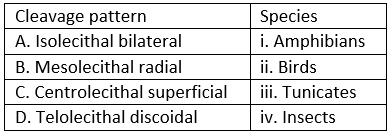
Correct option is D
Explanation-
A. Isolecithal bilateral - Tunicates (iii)
Isolecithal means yolk is evenly distributed throughout the egg. Bilateral cleavage occurs along a plane that divides the embryo into symmetrical right and left halves.
Tunicates (urochordates) are marine invertebrates that show this type of cleavage.
B. Mesolecithal radial - Amphibians (i)
Mesolecithal eggs have moderate amounts of yolk, concentrated more toward the vegetal pole. Radial cleavage means cells divide along planes perpendicular or parallel to the axis of the embryo, forming tiers of cells aligned above one another.
Amphibians (like frogs) display radial, holoblastic (complete) cleavage in mesolecithal eggs.
C. Centrolecithal superficial - Insects (iv)
Centrolecithal eggs have yolk concentrated in the center of the egg. Superficial cleavage happens only at the periphery, because the central yolk blocks cleavage through the center.
Insects (especially Drosophila) show this exact cleavage pattern.
D. Telolecithal discoidal - Birds (ii)
Telolecithal eggs have large amounts of yolk concentrated at one pole (the vegetal pole). Discoidal cleavage occurs only in a small disc of cytoplasm (blastodisc) at the animal pole.
Birds (e.g., chickens) show meroblastic discoidal cleavage due to the massive yolk.
So, the correct answer is option d - A - iii; B - i; C - iv; D - ii


