Correct option is B
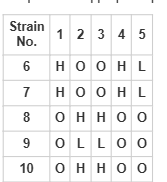
The following symbols are used for recombination frequencies:
- H represents "high recombination."
- L represents "low recombination."
- O represents "no recombination."
The high recombination (H) suggests that the strains are likely F+ or Hfr strains, capable of donating genetic material. Low recombination (L) suggests that the strains are genetically similar and are F- strains (cannot donate the F factor). No recombination (O) means that there is no genetic exchange between the strains.
Statement Analysis:
Statement A: "Strains 2, 3, 6, 7 are F-"
- F- strains cannot donate the F factor and typically show low or no recombination with other strains.
- From the recombination table:
- Strains 2, 3, 6, and 7 show low (L) or no (O) recombination, indicating that they do not carry the F factor, meaning they are F- strains.
- Statement A is correct.
Statement B: "Strains 2, 3, 5, 6, 7, 9 are F-"
- Strain 5 shows high recombination (H) with strain 1, suggesting it is an F+ strain and not F-.
- Therefore, Statement B is incorrect.
Statement C: "Strains 1, 4, 8, 10 are F+"
- F+ strains can donate the F factor during conjugation but do not have the F factor integrated into the chromosome as Hfr strains do. The recombination data (H and L) suggests that strains 1, 4, 8, and 10 can transfer the F factor, which aligns with F+.
- However, Statement C is incorrect because Strains 1, 4, 8, and 10 actually show high recombination rates (H), which indicate that they are likely Hfr strains (high-frequency recombination), where the F factor is integrated into the chromosome. This makes them more efficient in transferring both the F factor and additional genes during conjugation.
Statement D: "Strains 1, 4, 8, 10 are Hfr"
- Hfr strains have the F factor integrated into their chromosome, leading to high-frequency recombination. Strains 1, 4, 8, and 10 exhibit high recombination (H) with the other strains, indicating that they are Hfr strains.
- Statement D is correct.