Correct option is B
Given:
(x1,y1)(x2,y2)
(0,2)(1,-3)
Formula Used:
Y-Y1=m(X-X1)
m=
Solution:
m=
m = , m= -5
y-2= -5(x-0)
y - 2 +5x = 0
5x+y -2 = 0
Option (b)







Find the equation of the straight line passing through the points (0, 2) and (1, – 3).
Given:
(x1,y1)(x2,y2)
(0,2)(1,-3)
Formula Used:
Y-Y1=m(X-X1)
m=
Solution:
m=
m = , m= -5
y-2= -5(x-0)
y - 2 +5x = 0
5x+y -2 = 0
Option (b)
 English
 100 Questions
 100 Marks
 90 Mins English English100 Questions100 Marks90 Mins English English100 Questions100 Marks90 Mins English
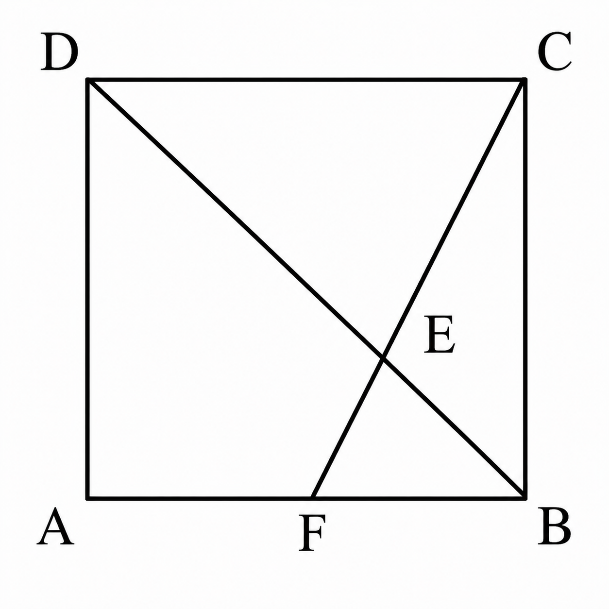
In the given figure, ABCD is a square. Angle DEC = 75 degrees. What is the value (in degrees) of angle EFA?
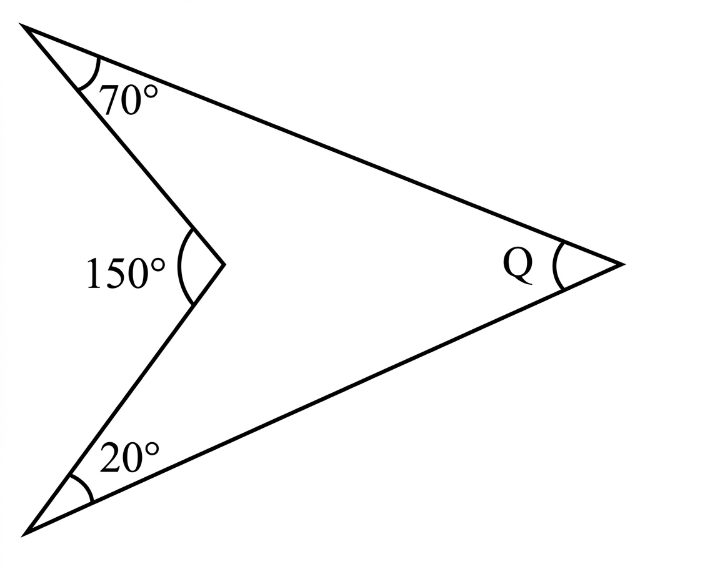
In the given figure, what is value (in degrees) of Q?
Let ABCD be a quadrilateral which satisfies any of the following conditions.
( i ) opposite sides are equal
( ii ) each diagonal of ABCD divides it into congruent triangles
( iii ) each pair of opposite angles are equal
( iv ) diagonals of ABCD bisect each other
Then ABCD has to be a _____________
How many diagonals can be there in a regular polygon with 37 sides?
A parallelogram is a quadrilateral in which:
The number of diagonals in a hexagon is :
ABCD is a trapezium in which BC || AD and AC = CD. If ∠ABC = 54° and ∠BAC = 60°, then what is the measure of ∠ACD (in degree)?
ABCD is a trapezium in which BC || AD and AC = CD. If ∠ABC = 19° and ∠BAC = 137°, then what is the measure of ∠ACD (in degree)?
The diagonals AC and BD of a parallelogram ABCD intersect each other at the point O. If ∠DAC = 32° and ∠AOB = 70°, then ∠DBC is equal to-
ABCD is a cyclic quadrilateral such that AB is a diameter of the circle circumscribing it and
Then is equal to:


Suggested Test Series

Suggested Test Series
In the given figure, ABCD is a square. Angle DEC = 75 degrees. What is the value (in degrees) of angle EFA?
In the given figure, what is value (in degrees) of Q?
Let ABCD be a quadrilateral which satisfies any of the following conditions.
( i ) opposite sides are equal
( ii ) each diagonal of ABCD divides it into congruent triangles
( iii ) each pair of opposite angles are equal
( iv ) diagonals of ABCD bisect each other
Then ABCD has to be a _____________
How many diagonals can be there in a regular polygon with 37 sides?
A parallelogram is a quadrilateral in which:
The number of diagonals in a hexagon is :
ABCD is a trapezium in which BC || AD and AC = CD. If ∠ABC = 54° and ∠BAC = 60°, then what is the measure of ∠ACD (in degree)?
ABCD is a trapezium in which BC || AD and AC = CD. If ∠ABC = 19° and ∠BAC = 137°, then what is the measure of ∠ACD (in degree)?
The diagonals AC and BD of a parallelogram ABCD intersect each other at the point O. If ∠DAC = 32° and ∠AOB = 70°, then ∠DBC is equal to-
ABCD is a cyclic quadrilateral such that AB is a diameter of the circle circumscribing it and
Then is equal to:
