Correct option is C
Given:
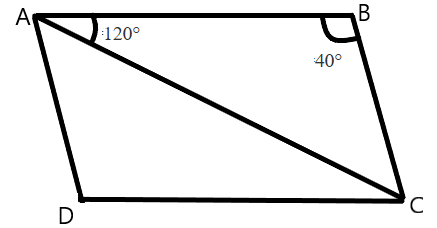
Trapezium ABCD with BC∥AD.
AC=CD so △ACD is isosceles with base AD.
∠ABC=40∘, ∠BAC=120∘.
Find ∠ACD.
Formula Used:
Triangle angle sum: ∠A+∠B+∠C=180∘.
In isosceles △ACD with AC = CD: base angles ∠CAD=∠ADC.
If two lines are parallel, corresponding/alternate interior angles with a transversal are equal.
Solution:
In △ABC:
∠BCA=180∘−∠BAC−∠ABC=180∘−120∘−40∘=20∘.
Since BC∥AD, the angle that CA makes with AD equals the angle it makes with BC. Hence
∠CAD=∠ACB=20∘.
In △ACD,AC=CD⟹∠CAD=∠ADC=20∘
Therefore
∠ACD=180∘−20∘−20∘=140∘.

 English
 100 Questions
 100 Marks
 90 Mins


