hamburger menu
All Coursesall course arrow
adda247
reward-icon
adda247
    arrow
    arrow
    arrow
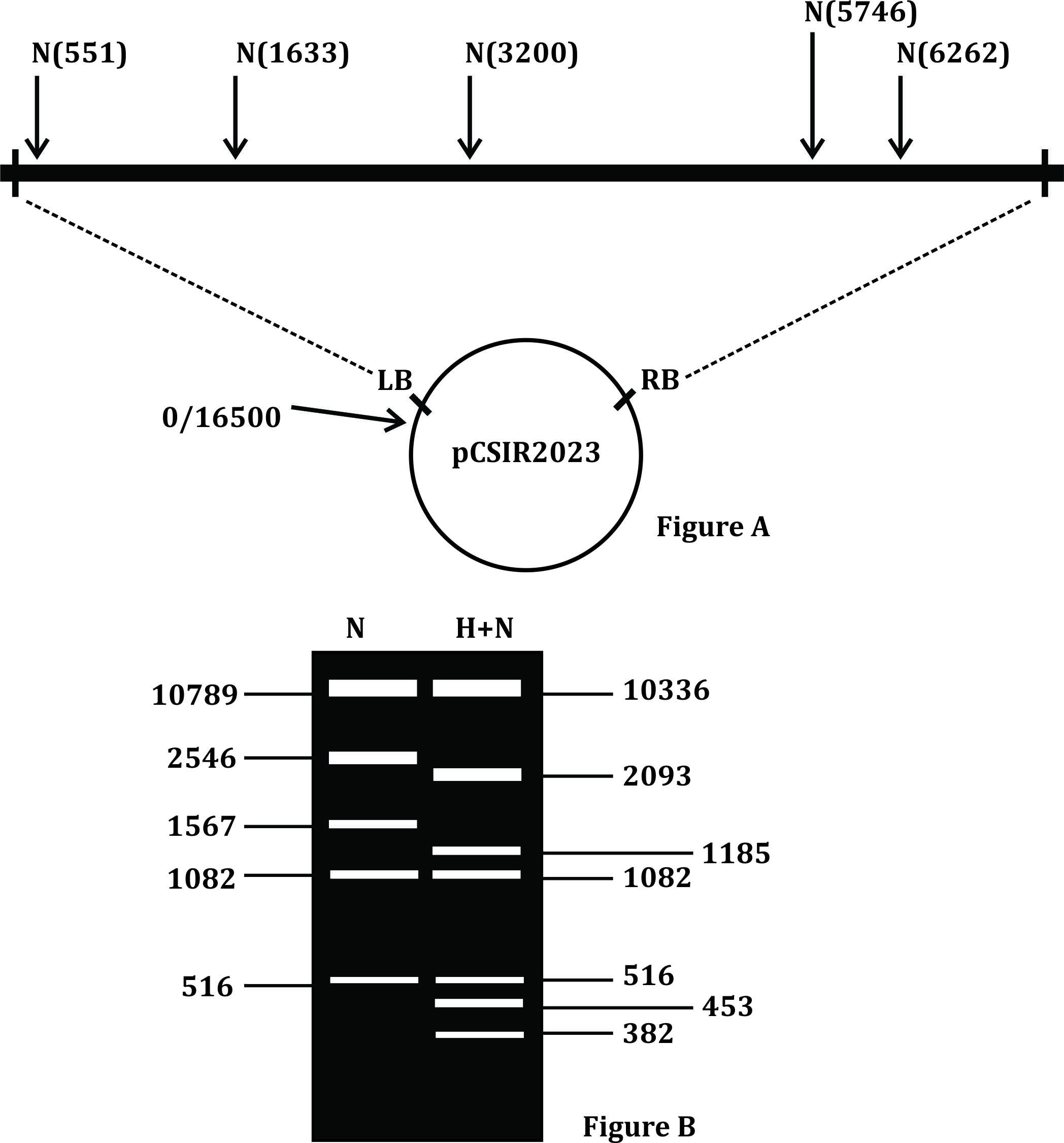
    ​Figure A represents the sites for NcoI (N) in a binary vector pCSIR2023. The vector is 16500 bp in size. Figure B represents the fragments observed w
    Question

    ​Figure A represents the sites for NcoI (N) in a binary vector pCSIR2023. The vector is 16500 bp in size. Figure B represents the fragments observed when the vector is either digested with NcoI (N) or double-digested with HindIII and NcoI (H+N). The intensity of the fluorescence of the 453 bp fragment is double that of the 516 bp fragment


    Which one of the following statements regarding the numbers and location(s) of HindIII sites is correct?

    A.

    There are two sites of HindIII, one of which is located in the ~11Kb fragment generated by NcoI digestion.

    B.

    There are three sites of HindIII, one of which is located in the ~1.6Kb fragment generated by NcoI digestion.

    C.

    There are three sites of HindIII, one of which is definitely at the 2015 position.

    D.

    There are four sites of HindIII, one of which is at the 2015 position.

    Correct option is B


    Explanation:

    Analysis of HindIII Sites in the Vector:

    • NcoI and HindIII Digestion:
      • NcoI digestion generates fragments such as 10789 bp, 10336 bp, and 1567 bp, and when NcoI and HindIII are combined, different fragments appear, such as 516 bp and 453 bp. These patterns help in locating the HindIII sites.
    • HindIII Sites:
      • In the double-digested vector, you can see the distinct fragment sizes, and from the pattern, you observe that one of the HindIII sites corresponds to a fragment size of ~1.6 Kb.
      • This suggests that one of the HindIII sites is indeed located in the ~1.6Kb fragment generated by NcoI digestion, which matches the digestion pattern for Option 2.
    • Three HindIII sites are present in the vector as observed from the fragment patterns.
    • One of the HindIII sites is located in the ~1.6Kb fragment generated by NcoI digestion. This is consistent with the analysis of the fragment sizes in Figure B.
    Similar Questions

    test-prime-package

    Access ‘CSIR NET Life Sciences’ Mock Tests with

    • 60000+ Mocks and Previous Year Papers
    • Unlimited Re-Attempts
    • Personalised Report Card
    • 500% Refund on Final Selection
    • Largest Community
    students-icon
    368k+ students have already unlocked exclusive benefits with Test Prime!
    test-prime-package

    Access ‘CSIR NET Life Sciences’ Mock Tests with

    • 60000+ Mocks and Previous Year Papers
    • Unlimited Re-Attempts
    • Personalised Report Card
    • 500% Refund on Final Selection
    • Largest Community
    students-icon
    368k+ students have already unlocked exclusive benefits with Test Prime!
    Our Plans
    Monthsup-arrow