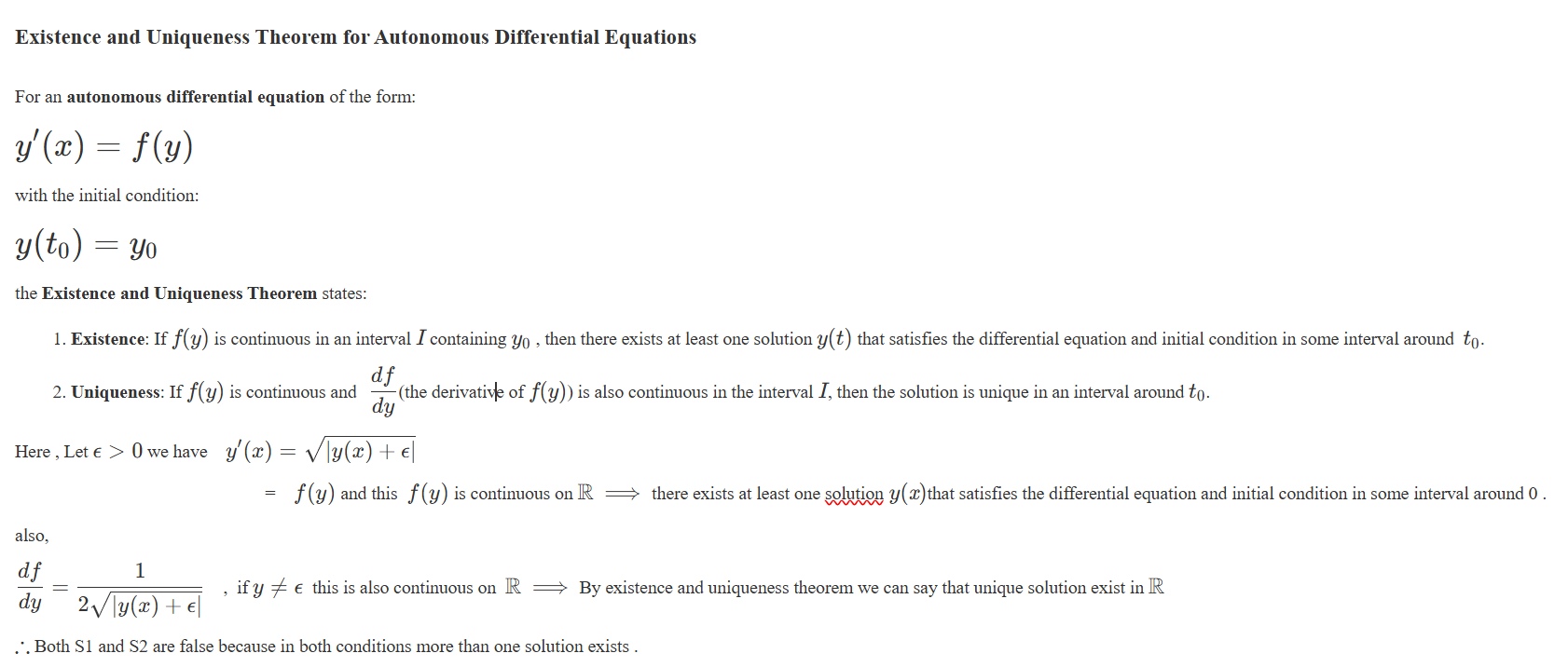
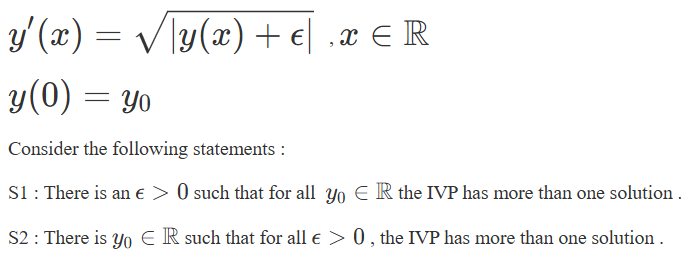
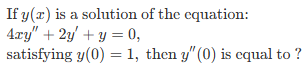
Consider the initial value problem (IVP)
Both S1 and S2 are true
S1 is true but S2 is false
S1 is false but S2 is true
Both S1 and S2 are false
Let y0>0, z0>0, α>1.Consider the following two differential equations:(∗)dydt=yαfor t>0,y(0)=y0(∗∗)dzdt=−zαfor t>0,z(0)=z0We say that the solution to a differential equation exists globally if it exists for all t>0.\text{Let } y_0 > 0, \ z_0 > 0, \ \alpha > 1. \\[10pt]\text{Consider the following two differential equations:} \\[10pt](*) \quad \frac{dy}{dt} = y^{\alpha} \quad \text{for} \ t > 0, \quad y(0) = y_0 \\[10pt](**) \quad \frac{dz}{dt} = -z^{\alpha} \quad \text{for} \ t > 0, \quad z(0) = z_0 \\[10pt]\text{We say that the solution to a differential equation exists globally if it exists for all } t > 0.Let y0>0, z0>0, α>1.Consider the following two differential equations:(∗)dtdy=yαfor t>0,y(0)=y0(∗∗)dtdz=−zαfor t>0,z(0)=z0We say that the solution to a differential equation exists globally if it exists for all t>0.
Which of the following statements is true?
For a positive integer n, let f(n)f^{(n)}f(n) denote the n-th derivative of f.
Suppose anentire function f satisfies: f(2)+f=0f^{(2)}+f=0f(2)+f=0
Which of the following is correct?
Let f:R2→R be continuous andf(t,x)<0if tx>0,f(t,x)>0if tx<0.Consider the problem of solving the following:x˙=f(t,x),x(0)=0.Which of the following is true?\text{Let } f : \mathbb{R}^2 \to \mathbb{R} \text{ be continuous and} \\[10pt]f(t, x) < 0 \quad \text{if } tx > 0, \\[10pt]f(t, x) > 0 \quad \text{if } tx < 0. \\[10pt]\text{Consider the problem of solving the following:} \\[10pt]\dot{x} = f(t, x), \quad x(0) = 0. \\[10pt]\text{Which of the following is true?}Let f:R2→R be continuous andf(t,x)<0if tx>0,f(t,x)>0if tx<0.Consider the problem of solving the following:x˙=f(t,x),x(0)=0.Which of the following is true?
Consider the ODE: ty′−3y=t2y1/2,y(1)=1.Find the value of y(2).\text{Consider the ODE: }\\t y' - 3y = t^2 y^{1/2}, \quad y(1) = 1.\\\text{Find the value of } y(2).Consider the ODE: ty′−3y=t2y1/2,y(1)=1.Find the value of y(2).
Consider the differential equation:x2y′′−2x(x+1)y′+2(x+1)y=0.If a polynomial is a solution, then the degree of the polynomial is equal to:\text{Consider the differential equation:} \\[10pt]x^2 y'' - 2x(x + 1)y' + 2(x + 1)y = 0. \\[10pt]\text{If a polynomial is a solution, then the degree of the polynomial is equal to:}Consider the differential equation:x2y′′−2x(x+1)y′+2(x+1)y=0.If a polynomial is a solution, then the degree of the polynomial is equal to:
For λ∈R, consider the system of differential equations:x1′=x1+2x2+2x3,x2′=2x2+x3,x3′=−x3+2x2+λx3.If x⃗(t)=a⃗ te2t (for some a⃗) is a solution of the system, then the value of λ is equal to.\text{For } \lambda \in \mathbb{R}, \text{ consider the system of differential equations:} \\x'_1 = x_1 + 2x_2 + 2x_3, \\x'_2 = 2x_2 + x_3, \\x'_3 = -x_3 + 2x_2 + \lambda x_3. \\[10pt]\text{If } \vec{x}(t) = \vec{a} \, t e^{2t} \, (\text{for some } \vec{a}) \text{ is a solution of the system, then the value of } \lambda \text{ is equal to.}For λ∈R, consider the system of differential equations:x1′=x1+2x2+2x3,x2′=2x2+x3,x3′=−x3+2x2+λx3.If x(t)=ate2t(for some a) is a solution of the system, then the value of λ is equal to.
Let k be a positive integer. Consider the differential equation{dydt=5ky5k+2,for t>0,y(0)=0Which of the following statements is true?\text{Let } k \text{ be a positive integer. Consider the differential equation} \\\begin{cases} \frac{dy}{dt} = \frac{5k}{y^{5k+2}}, & \text{for } t > 0, \\y(0) = 0 \end{cases} \\\text{Which of the following statements is true?}Let k be a positive integer. Consider the differential equation{dtdy=y5k+25k,y(0)=0for t>0,Which of the following statements is true?