Correct option is A
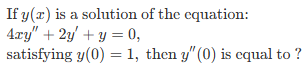
The given differential equation
x' = f(t, x), x(0) = 0
has f(t, x) as a continuous function, and the conditions
f(t, x) < 0 for tx > 0 andf(t, x) > 0 for tx < 0
imply that f(t, x) respects the sign of tx.
This propertyensures that f(t, x) satisfies the necessary conditions for both existence anduniqueness.
By the **Picard-Lindel¨of theorem**:
since f(t, x) is continuous and satisfiesthe local Lipschitz condition in x, the differential equation has a unique localsolution.
Correct Answer: (A).