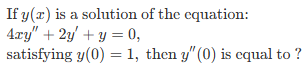
Correct option is A
Let y=a+bx, then:y′=b,y′′=0.Substituting into the differential equation:x2(0)−2x(x+1)b+2(x+1)(a+bx)=0.⟹−2bx2−2bx+2ax+2bx2+2a+2bx=0.⟹2ax+a=0.Comparing coefficients, we get:a=0,and b is arbitrary.⟹y=bx satisfies the equation and is a solution of degree 1.Now, let y=a+bx+cx2.Then, y′=b+2cx,y′′=2c.Substitute into the differential equation:x2(2c)−2x(x+1)(b+2cx)+2(x+1)(a+bx+cx2)=0.⟹2cx2−2x(bx+2cx2+b+2cx)+2(ax+bx2+cx3+a+bx+cx2)=0.⟹x3(−4c+2c)+x2(2c−2b−4c+2b+2c)+x(−2b+2b+2a)+2a=0.Comparing coefficients, we get:−4c=0⟹c=0,2a=0⟹a=0,and b is arbitrary.Thus, y=bx is a solution of degree 1.We can check polynomial of degree 3 and 4 also by this method result would be the same.