Correct option is C
Explanation-
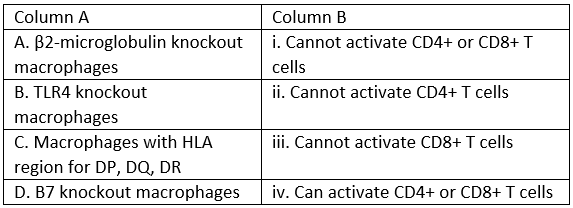
A. β2-microglobulin knockout macrophages → (iii) Cannot activate CD8⁺ T cells
β2-microglobulin is a non-polymorphic component of MHC Class I molecules. MHC Class I presents intracellular antigens (e.g., viral peptides) to CD8⁺ T cells (cytotoxic T cells). Without β2-microglobulin, MHC I cannot be properly expressed on the cell surface.
Result: CD8⁺ T cells cannot recognize antigens → no activation.
So, A matches iii: Cannot activate CD8⁺ T cells
B. TLR4 knockout macrophages → (iv) Can activate CD4⁺ or CD8⁺ T cells
TLR4 (Toll-like receptor 4) is part of the innate immune system. It detects lipopolysaccharides (LPS) from bacteria and helps initiate inflammation. TLR4 amplifies immune responses via cytokine production, but it is not essential for MHC I or II expression or for co-stimulatory molecules like B7. Even if TLR4 is missing, macrophages can still present antigen via MHC I and II and express co-stimulatory molecules.
Result: T cell activation can still happen, just possibly less efficiently.
So, B matches iv: Can activate CD4⁺ or CD8⁺ T cells
C. Macrophages with HLA DP, DQ, and DR deleted → (ii) Cannot activate CD4⁺ T cells
HLA-DP, DQ, and DR are MHC Class II molecules in humans. MHC Class II presents extracellular antigens to CD4⁺ T helper cells. Without these molecules, macrophages cannot present antigen to CD4⁺ T cells.
Result: CD4⁺ T cells don’t get activated.
So, C matches ii: Cannot activate CD4⁺ T cells
D. B7 knockout macrophages → (i) Cannot activate CD4⁺ or CD8⁺ T cells
B7 (CD80/CD86) is a co-stimulatory molecule required for full T cell activation.
T cells require two signals:
1. TCR recognition of MHC-peptide complex
2. Co-stimulation (e.g., B7 binding to CD28 on T cells)
Without B7, T cells recognize antigen but don’t get activated and may become anergic (functionally inactive).
Affects both CD4⁺ (via MHC II) and CD8⁺ (via MHC I) T cell activation.
So, D matches i: Cannot activate CD4⁺ or CD8⁺ T cells
Final Answer: A-iii, B-iv, C-ii, D-i (Option C)