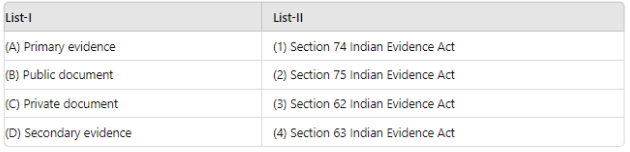
Correct option is D
Documentary evidence is covered under Chapter V of the Indian Evidence Act, 1872. This Chapter deals with the rules and provisions related to the admissibility, relevancy, and proof of documents in legal proceedings. It outlines how documents can be used as evidence in Court, the requirements for their admissibility, and the procedures for proving their contents.
Information Booster:
1. Chapter V: Focuses on documentary evidence, which includes any written or printed material used to prove a fact in court.
2. Admissibility: Outlines the criteria and conditions under which documents are admissible as evidence.
3. Relevancy: Defines the relevance of documents to the facts in issue.
4. Proof of Contents: Specifies how the contents of a document can be proved, including the use of primary and secondary evidence.
5. Sections Included: Covers Sections 61 to 90A, detailing various aspects of documentary evidence.
6. Legal Framework: Provides a comprehensive legal framework for handling documentary evidence in judicial proceedings.
Additional Information:
· Oral evidence (a): Covered under Chapter IV, Sections 59 and 60 of the Indian Evidence Act, which deals with evidence given by witnesses in the form of spoken words.
· Facts which need not be proved (b): Addressed in Chapter III, Sections 56 to 58, which include facts admitted by parties and judicially noticeable facts.
· Expert opinion (c): Covered under Chapter II, Sections 45 to 51, dealing with opinions of experts on matters of science, art, and other specialized knowledge.