






Correct option is B
The correct answer is: (b) i) Multiple substitutions, ii) Parallel substitution, iii) Convergent substitution, iv) Back substitution
Explanation:
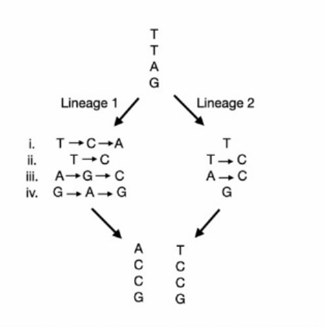
Each substitution pattern can be identified based on the changes observed in both lineages compared to the ancestral sequence TTAG.
i. T → C → A in Lineage 1 and T → C in Lineage 2:
The original base T changed to C in both lineages initially, and then to A in Lineage 1.
This is classified as multiple substitutions, because a base underwent more than one change over time.
ii. T → C in both lineages:
The same nucleotide change occurred independently in both lineages.
This is called parallel substitution.
iii. A → G → C in Lineage 1 and A → C in Lineage 2:
Both lineages ended up with C, but took different paths to reach it.
This is convergent substitution, where different evolutionary paths result in the same nucleotide.
iv. G → A → G in Lineage 1 and G remains G in Lineage 2:
The base changed to something else and then returned to the ancestral state.
This is a back substitution.
Information Booster:
Multiple substitutions refer to a case where a nucleotide undergoes more than one change along a lineage.
Parallel substitution occurs when the same substitution arises independently in different lineages.
Convergent substitution involves different changes leading to the same nucleotide across lineages.
Back substitution (or reversion) is when a nucleotide changes and then mutates back to the ancestral state.
These substitution types help in understanding phylogenetic relationships.
Analysis of such changes provides insight into molecular evolution and the rate of mutation.
They are used in constructing evolutionary trees and studying homoplasy (shared traits not due to common ancestry).


