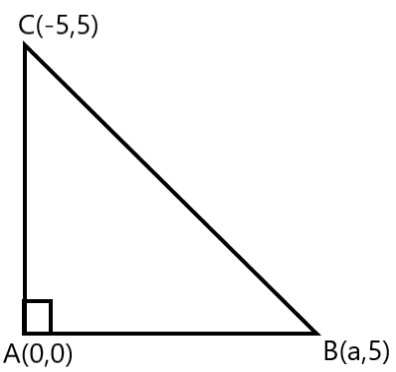
∆ABC is a triangle whose vertices are A(0, 0), B(a, 5) and C(-5, 5). If the triangle is right-angled at A, then find the value of a.
Question
∆ABC is a triangle whose vertices are A(0, 0), B(a, 5) and C(-5, 5). If the triangle is right-angled at A, then find the value of a.
A.
2
B.
5
C.
6
D.
3
Correct option is B
Given:
Vertices of triangle: A(0, 0), B(a, 5), C(-5, 5)
Triangle is right-angled at A
Formula Used:
The distance between two points (x1,y1) and (x2,y2) is given by:
Distance =(x2−x1)2+(y2−y1)2
Right angle is at A, the lengths of sides AB and AC must satisfy the Pythagorean theorem:
AB2+AC2=BC2
Solution:
The distance between A(0, 0) and B(a, 5) is:
AB =(a−0)2+(5−0)2=a2+25
The distance between A(0, 0) and C(-5, 5) is:
AC =(−5−0)2+(5−0)2=25+25=50
The distance between B(a, 5) and C(-5, 5) is:
BC = (a−(−5))2+(5−5)2=(a+5)2=∣a+5∣
Since the triangle is right-angled at A, we have:
AB2+AC2=BC2
(a2+25)+50=(a+5)2
a2+75=a2+10a+25
75 = 10a + 25
50 = 10a
a = 5
Alternate Method:
Concept Used: In a triangle right-angled at a point, the vectors from that point to the other two vertices are perpendicular. Two vectors are perpendicular if their dot product is zero.







 English
 100 Questions
 100 Marks
 90 Mins


