






Correct option is C
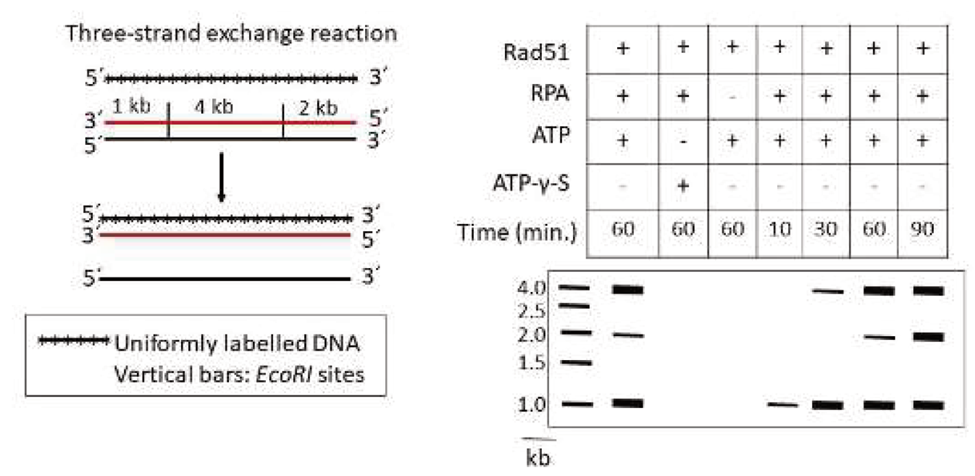
The experiment analyzes the three-strand exchange reaction and the role of Rad51 and RPA proteins, along with ATP or ATP-γS, in the strand-exchange mechanism. The reactions were terminated at various time points, and EcoRI was used to digest the DNA. The resulting DNA fragments were analyzed using electrophoresis and autoradiography.
Key Observations:
- The formation of hybrid DNA is observed at different time points, and the extent of the reaction depends on the presence of Rad51 and RPA, as well as ATP.
- When ATP-γS (a non-hydrolyzable form of ATP) is used, strand exchange does not occur as efficiently as when ATP is present.
- Strand exchange requires RPA, as there is no formation of hybrid DNA without it.
- The rate of strand-exchange is approximately 7 kb per hour, based on the observed time-course data.
Analysis of Statements:
Statement 1:Rad51 requires ATP hydrolysis for strand exchange reaction.
- Correct. ATP hydrolysis is essential for Rad51 to facilitate strand exchange, as the reaction does not occur with ATP-γS, a non-hydrolyzable form of ATP.
Statement 2:Strand exchange does not take place in the absence of RPA.
- Correct. The data shows that in the absence of RPA, strand exchange does not occur, as no hybrid DNA is formed.
Statement 3:The polarity of strand-exchange reaction is in the 3’ to 5’ direction.
- Incorrect. The typical polarity for strand exchange reactions facilitated by Rad51 occurs in the 5’ to 3’ direction, not the reverse. This statement contradicts the known mechanism of strand exchange.
Statement 4:The rate of strand-exchange is 7 kb/hour.
- Correct. Based on the experiment, the rate of strand exchange has been calculated to be approximately 7 kb per hour.


