






Correct option is C
Given:
First mixture: 12.5% salt, costs ₹22 per litre.
Second mixture: 27.5% salt, costs ₹38.50 per litre.
Required: How many litres of a mixture, of which 30% is salt, can be bought for ₹165?
Formula Used:
Using the allegation rule to find the required number of litres.
Solution:
Mixture Salt Price
P 12.5% → Rs. 22
Q 27.5% → Rs. 38.50
R 30% → Rs. 165
Mixture Q can be formed by mixing P and R
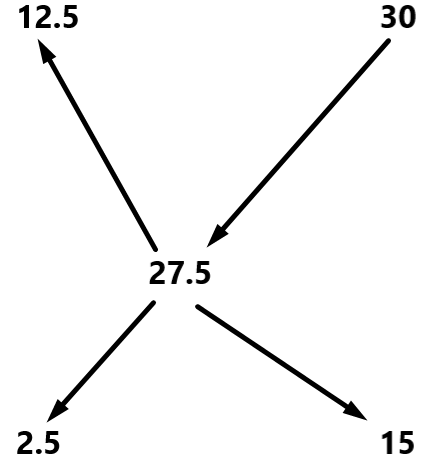
1 : 6
Cost should be in same ratio:
Let, salt of last mixture be R. x /litres
Cost → 22 : x
Ratio → 1 : 6
Average = Rs. 38.50 =
Average =
=
12x = 539 - 44
12x = 495
x = =
Then amount = = 4 litres
Therefore, 4 litres can be bought for ₹165.
Thus the correct option is (c) 4
Alternate Method:
Cost difference for the increase in salt percentage:
First mixture has 12.5% salt, costs ₹22 per litre.
Second mixture has 27.5% salt, costs ₹38.50 per litre.
The difference in salt percentage between the two mixtures is:
27.5% − 12.5% = 15%
The difference in cost for this 15% increase in salt concentration is:
₹38.50 - ₹22 = ₹16.50
So, the cost difference for a 15% increase in salt content is ₹16.50.
The cost increases for each 1% increase in salt concentration.
This means that for each 1% increase in salt content, the cost increases by ₹1.10.
The first mixture (12.5% salt) costs ₹22 per litre.
The cost increase for moving from 12.5% salt to 30% salt is:
So, the cost of the mixture with 30% salt will be:
₹22 + ₹19.25 = ₹41.25
Thus, the cost of 1 litre of the new mixture is ₹41.25.
Calculating the number of litres that can be bought for ₹165:
So, you can buy 4 litres of the mixture with 30% salt for ₹165.
 English
 80 Questions
 160 Marks
 60 Mins


