Correct option is C
Detailed Solution:
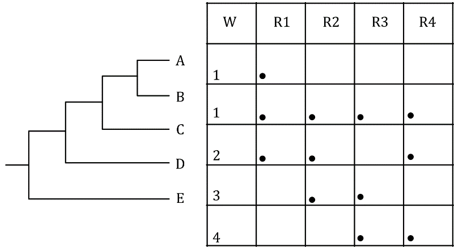
Step 1: Understanding Taxon Weights and Distribution
Weights (W) reflect taxonomic uniqueness of taxa:
A = 1
B = 1
C = 2
D = 3
E = 4 (most unique)
Step 2: Prioritizing Region R3 (Highest Priority)
R3 contains high-weight taxa E (4) and D (3).
Also contains B (1).
The presence of the most unique taxon E makes R3 the top priority.
Step 3: Prioritizing Region R1 (Second Priority)
R1 contains taxon A (1), which is unique only to R1.
Also contains B (1) and C (2).
Taxon A’s uniqueness and the presence of C (moderate weight) justify R1 as second priority despite lower total weight.
Step 4: Prioritizing Region R4 (Third Priority)
R4 shares taxa with R3, including the unique taxon E (4) and taxon C (2).
Although it shares taxa with R3, it is important for complementarity as it may cover species not in R1 or R2.
But presence of taxa overlapping with R3 reduces its priority compared to R1.
Step 5: Region R2 (Lowest Priority)
R2 has taxa B (1), C (2), and D (3).
However, these taxa are mostly present in other regions too.
Lack of unique taxa or high taxon weighting makes R2 least prioritized.