






Correct option is B
Let's analyze the Southern blot hybridization results and determine the correct statements.
Understanding the Southern Blot Results
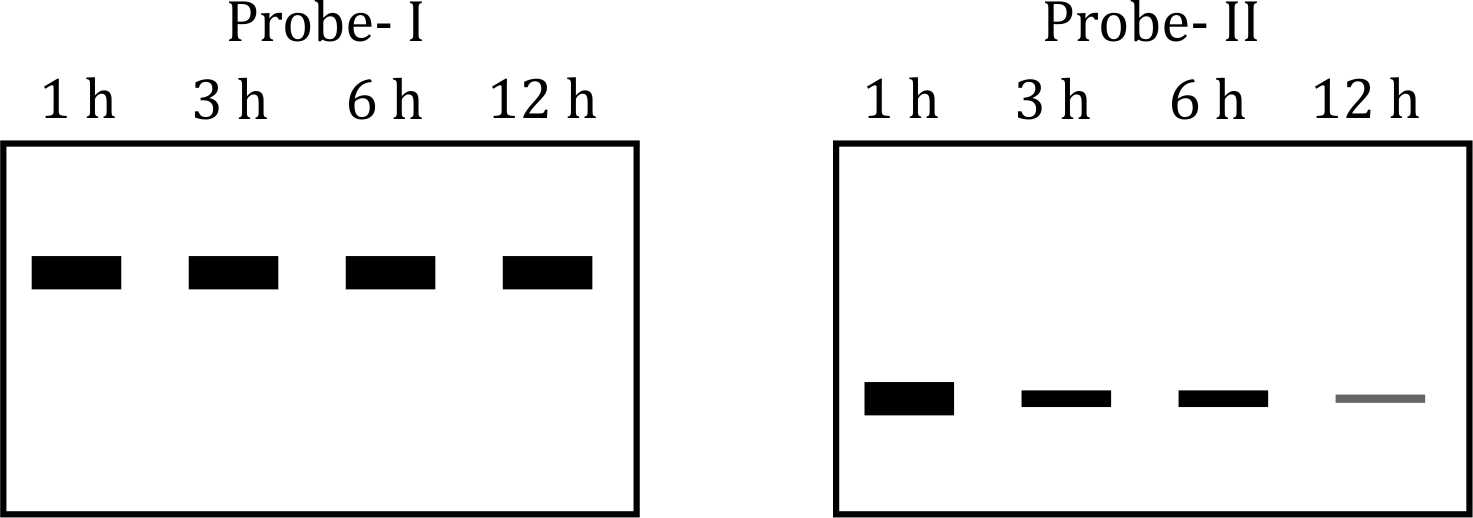
- Probe-I pattern: The band intensity remains similar across all time points (1h, 3h, 6h, 12h).
- Probe-II pattern: The bands decrease in intensity and size progressively over time, with almost no signal at 12h.
This suggests that:
- Probe-I hybridizes to a region resistant to nuclease digestion, implying a tightly packed, possibly heterochromatic or centromeric region.
- Probe-II hybridizes to a region that becomes increasingly digested over time, indicating it is located in euchromatin, which is more accessible to nucleases.
Evaluating the Given Statements
Statement A: "Size of probe-II is smaller than probe-I."
- The size of a probe is independent of the digestion pattern. The observed bands reflect chromatin accessibility, not probe size.
- Incorrect.
Statement B: "Probe-I may correspond to the centromeric region of the chromosome."
- The centromeric region is heterochromatic, making it resistant to digestion. Since the bands of Probe-I remain unchanged, it supports this possibility.
- Correct.
Statement C: "Probe-I may correspond to a hypomethylated locus of the genome."
- Hypomethylated regions are typically more open (euchromatin) and should be digested more easily.
- Since Probe-I remains undigested, this is Incorrect.
Statement D: "Probe-II may correspond to an euchromatic locus of the genome."
- Euchromatin is loosely packed and accessible to nucleases, leading to progressive digestion, which matches the pattern of Probe-II.
- Correct.
Correct Answer:
- Statements B and D are correct.
- Answer: Option 2 (B and D).


