
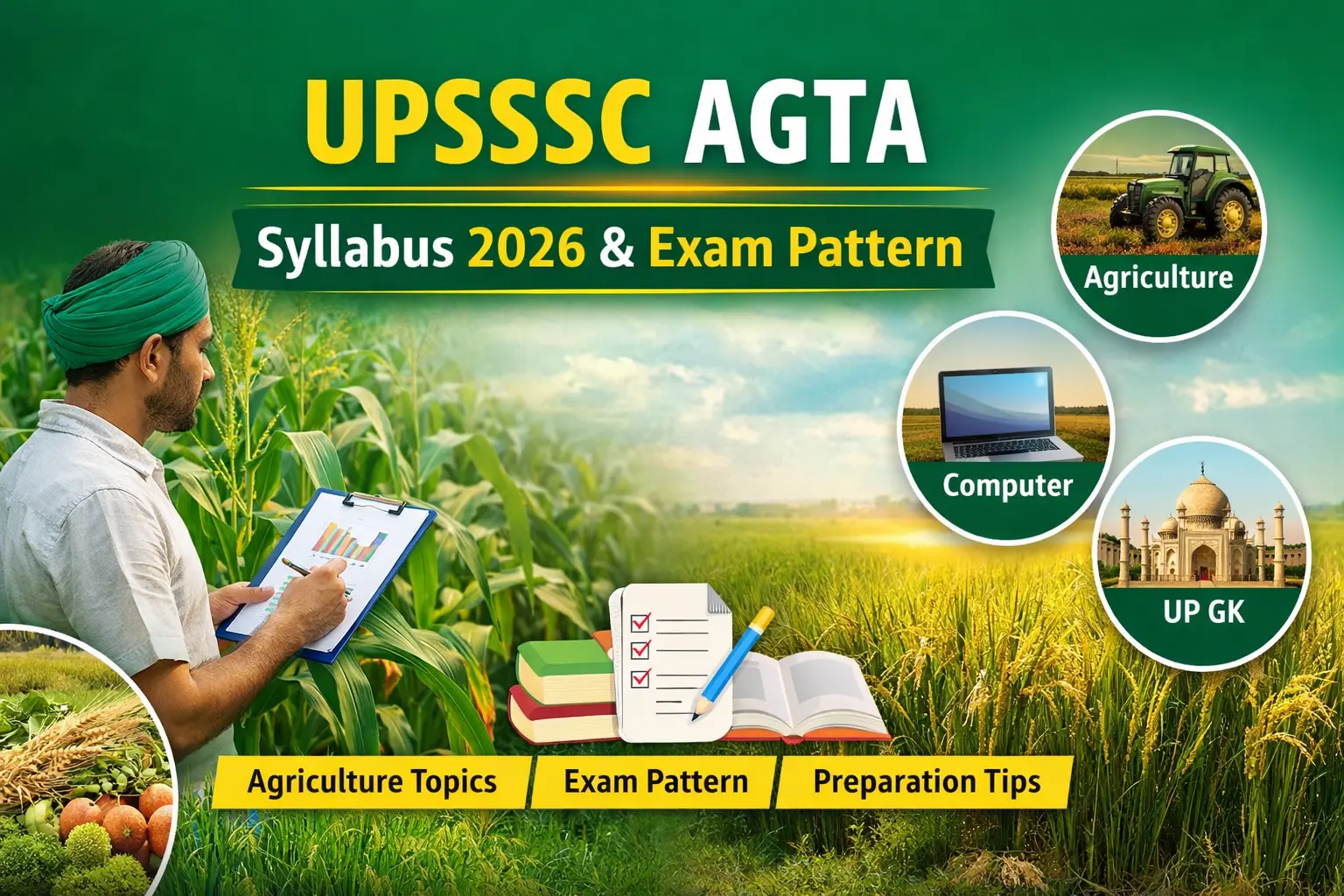
The UPSSSC AGTA Syllabus 2026 has been issued by the Uttar Pradesh Subordinate Services Selection Commission (UPSSSC) along with the recruitment notification for Agriculture Technical Assistant (AGTA) posts. Candidates aiming to qualify for the written examination should thoroughly understand the prescribed syllabus and exam pattern to plan their preparation effectively.
The selection process involves shortlisting based on PET scores, a written examination, and document verification. Familiarity with the subject-wise topics, number of questions, marking scheme, and overall exam structure can help candidates prepare in a focused manner. The detailed UPSSSC AGTA Syllabus and Exam Pattern 2026 are provided below.
UPSSSC AGTA Syllabus and Exam Pattern Highlights
For candidates aiming to crack the UPSSSC AGTA 2026 exam, it is important to understand the syllabus and exam pattern thoroughly. This helps candidates get familiar with the topics and marking scheme.
| UPSSSC AGTA Syllabus 2026 and Exam Pattern | |
| Organization | Uttar Pradesh Subordinate Services Selection Commission (UPSSSC) |
| Post name | Agriculture Technical Assistant (AGTA) |
| Type of Questions | Objective Type |
| Total number of questions | 100 Questions |
| Time Duration | 02 Hours |
| Negative Marking | 1/4 Mark |
| Total Marks | 100 marks |
| Official Website | www.upsssc.gov.in |
UPSSSC AGTA Selection Process 2026
The UPSSSC AGTA Selection Process 2026 consists of PET score-based shortlisting, a written examination, and document verification.
| Selection Stage | Details |
| Written Examination |
The exam consists of 100 objective-type questions carrying 100 marks. A negative marking of 0.25 marks will be applicable for each incorrect answer.
|
| Document Verification |
Candidates who qualify in the written examination will be called for the document verification process to verify their eligibility and submitted certificates.
|
UPSSSC AGTA Syllabus 2026
Before starting the detailed UPSSSC AGTA Syllabus 2026, candidates should understand the exam structure and key subjects. The syllabus tests agriculture knowledge along with computer awareness and Uttar Pradesh GK, helping candidates plan preparation and focus on important topics for better scoring.
Are You Preparing for UPSSSC AGTA Exam 2026?
Part-1: Agriculture Subject
1. Crop Science
- Classification of crops, major cereals, pulses, oilseeds, millets, fiber, cash crops, spices, fodder, fruits, flowers, and vegetable crops grown in the state, along with production techniques and agro practices.
- Post-harvest management of produce.
- Fruits and vegetables preservation and processing.
- Principles of crop rotation, cropping patterns, and farming types (dry farming, integrated farming, natural farming, mono-cropping, multiple cropping, intercropping).
- Types, importance, and socio-economic use of organic farming.
- Importance of seeds, types, production methods, and seed treatment.
- Crop protection principles, equipment, pest control chemicals, and integrated pest management.
- Insects, pests, and diseases of major crops and their management.
- Produce storage systems, quality factors, and management.
2. Biotechnology, Plant breeding & Crop physiology
- Importance and utility of Biotechnology in agriculture.
- Principles, use, and importance of Genetics & Plant Breeding.
- Photosynthesis, Respiration, Evaporation, Plant Anatomy, and Metabolism.
3. Soil and Water Conservation
- Soil properties, components, formation process, erosion types, and conservation techniques.
- Essential soil nutrients and deficiency symptoms.
- Fertilizer classification, nutrient content, and application methods.
- Integrated nutrient management, bio-fertilizers, and organic fertilizers.
- Soil microbiology and its role in crop production.
- Soil survey, sampling methods, and conservation techniques.
- Irrigation sources and methods.
- Drainage concepts and Watershed Management.
- Types of pollution and environmental protection.
4. Agriculture Extension
- Principles of agriculture extension and rural development.
- Extension methodologies and audio-visual aids.
- Training objectives, importance, and types.
- Government schemes for farmers and rural development.
5. Agriculture Economics & Schemes
- Role of agriculture in the One Trillion economy of UP.
- Economic reforms, import/export concepts, and agriculture planning.
- Agricultural statistics and economics principles.
- Minimum Support Price (MSP) and Agricultural Marketing.
6. Dairy & Animal Husbandry
- Animal breeds, feed management, and animal breeding.
- Milk production and distribution.
- Poultry farming, Fish farming, Apiculture (bees), and Sericulture (silk).
- Major domestic animal diseases, diagnosis, and treatment.
Part-2: Computer and Information Technology
- Fundamentals: History, introduction, and application of Computers, IT, Internet, and WWW.
- General Knowledge Topics: Hardware/Software, Input/Output, IP Addresses, IT gadgets, Email operation, Mobile/Tablet/Printer operation.
- Software & Tools: MS Word, MS Excel, Operating Systems, Social Networking, e-Governance, and Digital Financial Tools.
- Advanced Tech: Future Skills, Cyber Security, Artificial Intelligence, Big Data, Deep Learning, Machine Learning, Internet of Things (IoT), and India’s achievements in the IT field.
Part-3: General Information Related to Uttar Pradesh
- Questions covering UP’s History, Culture, Art, Architecture, Festivals, Folk Dance, Literature, Regional Languages, Heritage, and Social Customs.
- Tourism, Geographical Landscape, Environment, Natural Resources, Climate, Soil, Forests, Wildlife, and Mines/Minerals.
- Economy, Agriculture, Industry, Business, Employment, Polity, Administration, Current Events, and State Achievements.
UPSSSC AGTA Exam Pattern 2026
Understanding the UPSSSC AGTA Syllabus 2026 and exam pattern is essential for effective preparation. The exam comprises 100 objective-type questions with a duration of two hours and negative marking for wrong answers.
- Type of Examination: Objective Type Multiple Choice Questions (MCQs)
- Total Questions: 100
- Total Marks: 100
- Duration: 2 Hours (120 Minutes)
- Negative Marking: Yes, 25% (¼ mark) will be deducted for each incorrect answer.
| Part | Subject | Number of Questions | Total Marks |
| Part-1 | Crop Science | 25 | 25 |
| Biotechnology, Plant Breeding & Crop Physiology | 10 | 10 | |
| Soil and Water Conservation | 15 | 15 | |
| Agriculture Extension | 05 | 05 | |
| Agriculture Economics & Schemes | 05 | 05 | |
| Dairy & Animal Husbandry | 05 | 05 | |
| Part-2 | Knowledge of Concepts of Computer and Information Technology and Contemporary Technological Development | 15 | 15 |
| Part-3 | General Information Related to the State of Uttar Pradesh | 20 | 20 |
| Total | 100 | 100 |
Best Books for UPSSSC AGTA 2026
Selecting the right study material is essential to cover the UPSSSC AGTA Syllabus 2026 effectively. Candidates should refer to standard Agriculture books along with Computer Knowledge and Uttar Pradesh GK books to strengthen their preparation. Below are some of the recommended books for the UPSSSC AGTA Exam.
| Subject | Recommended Book |
|---|---|
| Agriculture | A Competitive Book of Agriculture – Nem Raj Sunda |
| Agriculture (Reference) | Handbook of Agriculture – ICAR |
| Computer Knowledge | Lucent’s Computer |
| Uttar Pradesh GK | Uttar Pradesh General Knowledge – Arihant |
Candidates should complete the UPSSSC AGTA Syllabus 2026 well in advance. Since Agriculture carries maximum weightage, it should be prioritized along with Computer Knowledge and UP GK. Regular revision and practice of previous year papers will improve accuracy and performance.
| Also check |
| UPSSSC AGTA Salary |
| UPSSSC AGTA Previous Year Papers |






 Assam FSO Syllabus And Exam Pattern 2026...
 UPPSC RO ARO Vacancy 2026 Out For 502 Po...
 UPPSC RO ARO Cut Off 2026, Check Expecte...


 Adda247 Job portal has complete information about all Sarkari Jobs and Naukri Alerts, its latest recruitment notifications, from all state and national level jobs and their updates.