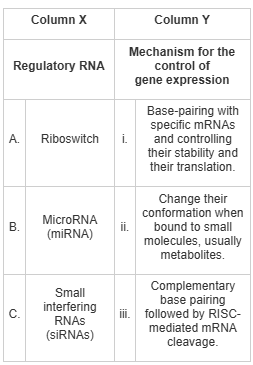
Correct option is C
The incorrect statement is that "mRNA transcript of an operon has only one Shine-Dalgarno sequence upstream of the first open reading frame." In reality, in polycistronic mRNA (which is typical in bacterial operons), each open reading frame (ORF) typically has its own Shine-Dalgarno sequence, located upstream of the respective start codon. The Shine-Dalgarno sequence serves as a ribosome-binding site, ensuring that translation initiation can occur independently for each protein-coding region within the same mRNA.
Thus, each cistron in the operon requires its own Shine-Dalgarno sequence to facilitate the independent initiation of translation. Without these multiple binding sites, the ribosome would not be able to initiate translation for the internal ORFs efficiently.
Information Booster:
- Operons are clusters of genes under the control of a single promoter, transcribed into a single polycistronic mRNA.
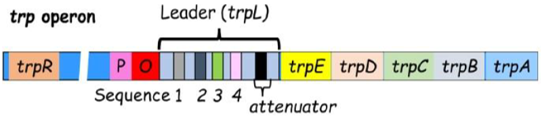
- Polycistronic mRNA can encode multiple proteins, usually involved in a related function or pathway (e.g., lac operon, trp operon).
- Each gene within an operon typically has its own Shine-Dalgarno sequence, enabling independent translation.
- The Shine-Dalgarno sequence is a ribosome-binding site in bacterial mRNA, located ~6-10 bases upstream of the start codon.
Additional Information:
- (a) Operons can encode multiple proteins with linked biological activity: This is correct; for example, enzymes in a metabolic pathway are often encoded in a single operon.
- (b) An operon expresses multiple proteins from a single mRNA: Also correct. The single mRNA is polycistronic and encodes multiple proteins.
- (d) Operon expression is often tightly regulated: This is a true statement. Bacteria control gene expression finely, responding to nutrient availability or environmental signals.
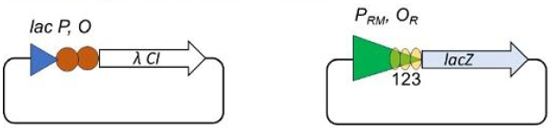
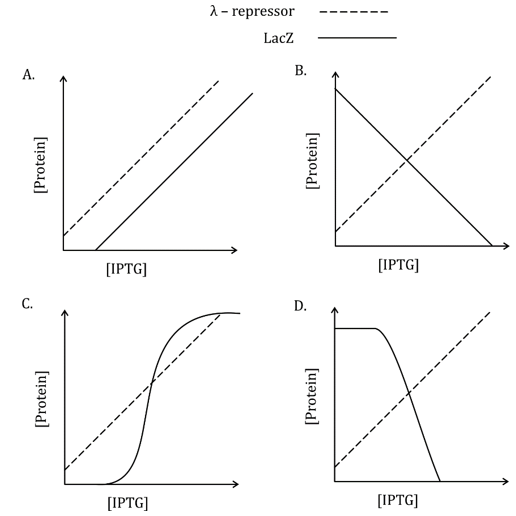
 which one of the following statements about the regulation by CI and Cro proteins is CORRECT?