Correct option is D
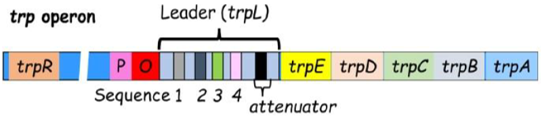
The trp operon is regulated by attenuation, a mechanism relying on the formation of alternative secondary structures in the leader sequence (trpL). Depending on ribosome position, either the 3:4 terminator forms (leading to attenuation), or the 2:3 anti-terminator forms (allowing transcription).
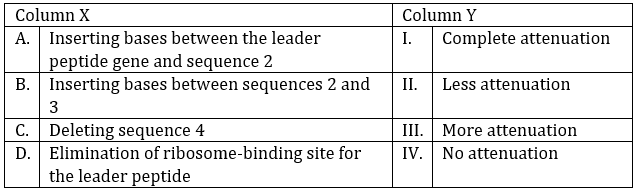
A. Inserting bases between the leader peptide gene and sequence 2
Inserting bases between the leader peptide gene and sequence 2 will disrupt the normal pairing of the mRNA transcript in the attenuator region. This disruption will likely affect the formation of terminator loop, promoting the formation of anti- terminator loop instead .This allows the RNA Polymerase to continue transcribing , this will ultimately reduce attenuation , but not completely eliminate it.
Thus, Results in less attenuation.
Correct Match: A → ii
B. Inserting bases between sequences 2 and 3
This prevents proper 2:3 anti-terminator pairing.
So, 3:4 terminator forms more often.
Results in more attenuation.
Correct Match: B → iii
C. Deleting sequence 4
This removes the terminator pairing region.
No 3:4 terminator = transcription continues.
No attenuation.
Correct Match: C → iv
D. Elimination of ribosome-binding site for the leader peptide
Leader peptide is not translated at all.
Ribosome doesn’t occupy sequence 1.
Sequence 1 pairs with 2, preventing 2:3 anti-terminator.
3:4 terminator forms readily.
Results in complete attenuation.
Correct Match: D → i
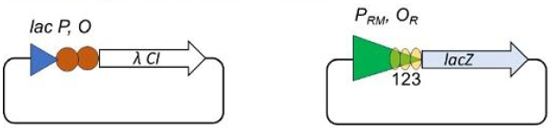
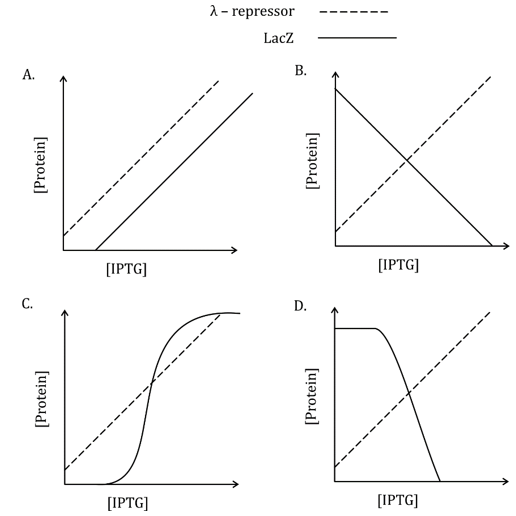
 which one of the following statements about the regulation by CI and Cro proteins is CORRECT?