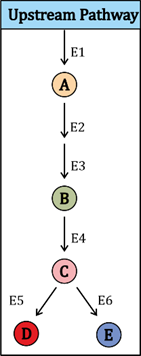
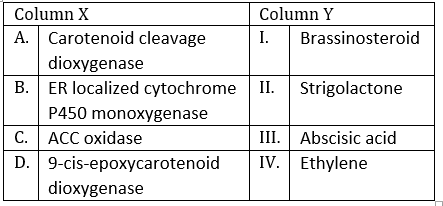
Correct option is C
The correct answer is option (c): Inactivation of ABA involves its oxidation to phaseic acid. The inactivation of abscisic acid (ABA), a key phytohormone involved in many processes such as seed dormancy, water stress response, and stomatal regulation, involves its conversion into phaseic acid. This process is a form of metabolic inactivation and plays an essential role in regulating ABA levels in plants. Phaseic acid is biologically inactive compared to ABA, and the conversion of ABA into phaseic acid helps modulate the physiological responses controlled by ABA.
Information Booster:
Inactivation of ABA to phaseic acid: The inactivation of ABA involves its conversion into phaseic acid, a biologically inactive compound. This process is crucial in the regulation of ABA levels in plants, especially during processes like seed maturation and dormancy. The conversion is catalyzed by the enzyme ABA 8'-hydroxylase, which oxidizes ABA to phaseic acid. This is a key step in modulating ABA's action in plant growth and stress responses.
Vivipary and ABA: ABA plays an essential role in seed dormancy and inhibiting vivipary. During seed maturation, ABA accumulates to promote dormancy and prevent premature germination. In conditions of low ABA levels, seeds may germinate prematurely, leading to vivipary. This process is detrimental to plant survival as the seeds need to stay dormant until environmental conditions are favorable for germination.
ABA-β-D-glucosyl ester: The ABA-β-D-glucosyl ester is a conjugate of ABA and glucose, which is a storage form. This conjugated form does not possess the biological activity of free ABA, which is required for regulatory functions like stomatal closure and seed dormancy.
ABA biosynthesis in plastids: ABA biosynthesis starts in the plastids with the conversion of carotenoids to xanthophylls and eventually to ABA. However, the final steps of ABA synthesis take place in the cytoplasm, where the enzyme zeaxanthin epoxidase and other enzymes work to form ABA from its precursors. This dual compartmentalization highlights the complexity of ABA biosynthesis.
Additional Information:
Option (a): Incorrect. A high level of ABA prevents vivipary by inducing seed dormancy. In contrast, low ABA levels allow seeds to germinate prematurely.
Option (b): Incorrect. ABA-β-D-glucosyl ester is a conjugated and inactive form of ABA, serving as a storage molecule. The active form of ABA is the free hormone.
Option (d): Incorrect. ABA biosynthesis occurs in both plastids (for early steps) and the cytoplasm (for final steps), so it is not entirely in the plastids.