

arrow
arrow
arrow
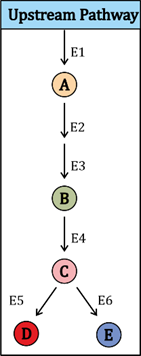
The figure below depicts a hypothetical scheme for synthesizing a target product in plants. (A),(B), and (C) are the precursors of a target product D,
Question

The figure below depicts a hypothetical scheme for synthesizing a target product in plants. (A),(B), and (C) are the precursors of a target product D, whereas E is a by-product. The key enzymes of the pathway are indicated as E1–E6. To enhance the levels of target product D, following strategies were tested:

A. Enhancing the activity of the enzyme E5 by over-expression and/or protein engineering.

B. Enhancing the activity of the enzyme E4 by over-expression and/or protein engineering.
C. Enhancing the levels of C.
D. Blocking the activity of E6 by RNA-interference or CRISPR/Cas-mediated knockout.

Which of the above mentioned strategies are likely to provide the maximum enhancement of the target product compared to the by-product, if no feedback regulation exists for any of the enzymes in the pathway?

A.

A and B

B.

B and C

C.

C and D

D.

A and D

Correct option is D

Explanation-

A-  Enhancing activity of E5 by overexpression and protein engineering.
             E5 converts C → D.
             Increasing E5 activity means:
                                   1.     More C is used to produce D.
                                   2.     Pulls more flux toward D.
If C is available, increasing E5 helps siphon C away from the branch that makes E.
this helps increase the target product D.

B -  Enhancing activity of E4  by overexpression and protein engineering.

             E4 converts B → C.
             Increasing E4 increases C.
But C is used by both E5 (→D) and E6 (→E). If E5 and E6 remain unchanged, this just boosts both D and E, not D preferentially.
So, it increases both target and by-product without selectivity.

 C -  Enhancing levels of C
Manually increasing C levels has the same effect as Option B. C is still used by both E5 and E6. So both D and E may increase, again without bias toward the target.
But  not targeted enough to help only D.

D -  Blocking activity of E6  by RNA-interference or CRISPR/Cas-mediated knockout.
             E6 converts C → E (the by-product).
             Knocking out or inhibiting E6:
                                                1.       Eliminates the competing pathway.
                                                2.       All available C now goes toward D via E5.
                                                3.       Greatly increases selectivity for D.
This directly prevents by-product formation and boosts D.

Statement  A and D- Correct 
When used together, these two strategies are synergistic:
                                           A pushes the pathway toward making D faster.
                                           D blocks the competing route to E, making sure all C goes to D.
This ensures that the flux is both directed and unimpeded, maximizing target product formation. These strategies maximize D (target product) and minimize E (by-product) most effectively when there’s no feedback inhibition in the pathway.

So, the correct answer is option d - A and D


Similar Questions

test-prime-package

Access ‘CSIR NET Life Sciences’ Mock Tests with

  • 60000+ Mocks and Previous Year Papers
  • Unlimited Re-Attempts
  • Personalised Report Card
  • 500% Refund on Final Selection
  • Largest Community
students-icon
354k+ students have already unlocked exclusive benefits with Test Prime!
test-prime-package

Access ‘CSIR NET Life Sciences’ Mock Tests with

  • 60000+ Mocks and Previous Year Papers
  • Unlimited Re-Attempts
  • Personalised Report Card
  • 500% Refund on Final Selection
  • Largest Community
students-icon
354k+ students have already unlocked exclusive benefits with Test Prime!
Our Plans
Monthsup-arrow

