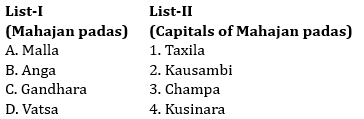
Correct option is A
"Usually tax on crops was fixed at ½ (half) of what was produced" is not true for the Mahajanapadas regarding the collection of regular taxes.
During the period of the Mahajanapadas, the usual tax on crops was typically one-sixth of the produce, known as Bhaga. This was a standard rate for agricultural taxation, and it was not as high as half of the produce.
Information Booster:
· The Mahajanapadas were large states that existed in ancient India during the 6th century BCE, with structured economies and taxation systems.
· The agricultural tax, Bhaga, was typically fixed at one-sixth of the produce, not half.
· Herders, traders, and hunters were all subject to various forms of taxes, either in kind (animals, goods) or through barter systems.
· Forest produce collected from hunters and gatherers was used to support the king's court and administrative systems.
· The taxation system in the Mahajanapadas was crucial for maintaining the state's economy and funding its military and administrative structures.
Additional Knowledge:
· Option (a) is incorrect because a tax rate of half of the produce would have been too high and unsustainable for farmers.
· Option (b), (c), and (d) accurately reflect the taxation practices of the Mahajanapadas.
· The system of taxation was designed to support the growing administrative needs of these early states while keeping the tax burden manageable for the population.
 English
 150 Questions
 150 Marks
 150 Mins