Correct option is C
Option C - The unpaired t-test (also known as the independent t-test) is a parametric test that compares the means of two independent groups. It assumes that the data are normally distributed and that the variances in both groups are equal.
1. Parametric Tests
Parametric tests are statistical tests that make certain assumptions about the parameters (such as the mean and variance) of the population from which the data are drawn. These tests assume that the data follow a specific distribution, typically the normal distribution.
Common Parametric Tests:
- Unpaired t-test: Compares the means of two independent groups.
- Paired t-test: Compares the means of two related groups.
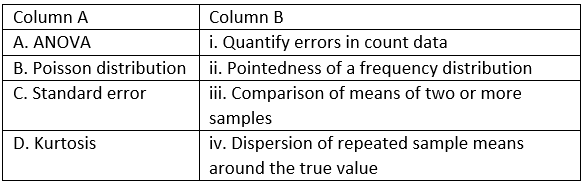
- ANOVA (Analysis of Variance): Compares the means of three or more independent groups.
- Pearson’s correlation: Measures the strength and direction of the linear relationship between two continuous variables.
- Linear regression: Used for modeling relationships between variables.
2. Non-Parametric Tests
Non-parametric tests do not assume that the data come from a specific distribution. They are more flexible and can be used when the assumptions of parametric tests (normal distribution, homogeneity of variance) are not met.
Common Non-Parametric Tests:
- Mann-Whitney U test: Used to compare two independent groups when the data is not normally distributed.
- Wilcoxon signed-rank test: Used to compare two related groups when data is not normally distributed.
- Kruskal-Wallis test: Non-parametric alternative to one-way ANOVA, used to compare three or more independent groups.
- Friedman test: Non-parametric alternative to repeated-measures ANOVA.
- Spearman's rank correlation: Measures the strength and direction of a monotonic relationship between two variables.
- Chi-square test: Tests for associations between categorical variables.
- Fisher's exact test: A non-parametric test used for categorical data, particularly for small sample sizes.