Correct option is C
Explanation-
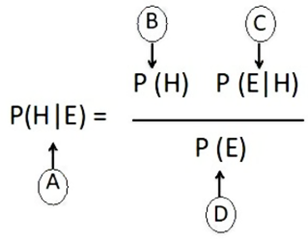
Bayes’ Theorem is a mathematical formula used to calculate the probability of a hypothesis (H) given some observed evidence (E). It’s written as:
This tells us how to update our belief in a hypothesis after seeing evidence.
A: (∣)
This is the Posterior Probability.
Meaning: After seeing evidence E, what's the probability that the hypothesis H is true?
It's the updated belief.
B: ()
This is the Prior Probability.
Meaning: Before seeing any evidence, what did we believe about the likelihood of H being true?
It reflects initial belief or background knowledge.
C: (∣)
This is the Likelihood.
Meaning: If hypothesis H is true, how likely are we to observe evidence E?
It tells how well H explains E.
D: ()
This is called Evidence or Marginal Likelihood.
Meaning: What's the overall probability of observing E, across all possible hypotheses?
It normalizes the result and ensures the posterior is a proper probability.
Final Answer: Option c
A – Posterior probability
B – Prior probability
C – Likelihood
D – Evidence