

hamburger menu
All Coursesall course arrow
adda247
reward-icon
adda247
    arrow
    arrow
    arrow
    ​Which one of the following statements is correct?​
    Question

    Which one of the following statements is correct?

    A.

    If a transgenic plant heterozygous for an insert segregates into 1:1 ratio for the transgenic phenotype on back-crossing then it contains two unlinked copies of the insert.

    B.

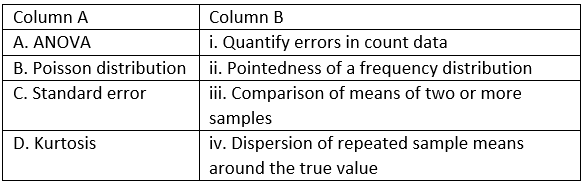
    ANOVA allows a plant breeder to test whether measurements from three or more treatments show statistically significant differences.
    C.

    Comparative genomics allows scientists to identify regions of collinearity but not synteny between different species.

    D.

    For genetic mapping of a quantitative trait in plants, an RIL mapping population comprising of individuals that are heterozygous at most loci is preferred.

    Correct option is B

    Explanation-

    Option a : If a transgenic plant heterozygous for an insert segregates into 1:1 ratio for the transgenic phenotype on back-crossing then it contains two unlinked copies of the insert - INCORRECT
    If a transgenic plant is heterozygous for two unlinked insertions, on backcrossing, you generally expect a more complex segregation ratio than 1:1. A 1:1 ratio is expected when there is only one insertion that is heterozygous.
    Option b : ANOVA allows a plant breeder to test whether measurements from three or more treatments show statistically significant differences  - CORRECT
    ANOVA (Analysis of Variance) is a statistical method used to compare means among three or more groups to see if at least one group differs significantly from others.
    Option c: Comparative genomics allows scientists to identify regions of collinearity but not synteny between different species  -  INCORRECT
    Comparative genomics helps identify both collinearity (same order of genes) and synteny (presence of the same genes on the same chromosome) across species.
    Option d : For genetic mapping of a quantitative trait in plants, an RIL mapping population comprising of individuals that are heterozygous at most loci is preferred - INCORRECT
    RILs (Recombinant Inbred Lines) are typically homozygous at most loci after several generations of selfing. Heterozygosity is actually reduced during RIL development to make stable lines for mapping.

    Correct Answer: Option b - ANOVA allows a plant breeder to test whether measurements from three or more treatments show statistically significant differences.
    Similar Questions

    test-prime-package

    Access ‘CSIR NET Life Sciences’ Mock Tests with

    • 60000+ Mocks and Previous Year Papers
    • Unlimited Re-Attempts
    • Personalised Report Card
    • 500% Refund on Final Selection
    • Largest Community
    students-icon
    353k+ students have already unlocked exclusive benefits with Test Prime!
    test-prime-package

    Access ‘CSIR NET Life Sciences’ Mock Tests with

    • 60000+ Mocks and Previous Year Papers
    • Unlimited Re-Attempts
    • Personalised Report Card
    • 500% Refund on Final Selection
    • Largest Community
    students-icon
    353k+ students have already unlocked exclusive benefits with Test Prime!
    Our Plans
    Monthsup-arrow

