Correct option is D
Bryophytes (mosses, liverworts, and hornworts) are non-vascular plants that lack true vascular tissues like xylem and phloem. However, some mosses have specialized water-conducting cells called hydroids, but not all bryophytes possess them.
- Hydroids are found only in some mosses (e.g., Polytrichum).
- Liverworts and hornworts do not have hydroids; instead, they rely on capillary action and diffusion for water transport.
- Since not all bryophytes use hydroids for water conduction, statement (4) is incorrect.
Information Booster
Homosporous Nature:
- All bryophytes produce only one type of spore (homosporous).
- These spores grow into a bisexual gametophyte.
Dominant Gametophyte Phase:
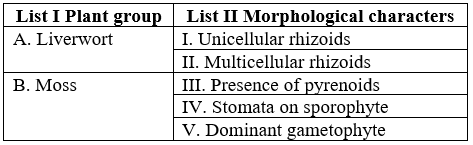
- Unlike vascular plants where the sporophyte is dominant, bryophytes have a dominant gametophyte phase.
- The sporophyte is dependent on the gametophyte for nutrition.
Biflagellate Antherozoids:
- The male gametes (antherozoids) in most bryophytes are biflagellate, meaning they have two flagella for swimming.
- However, some hornworts and liverworts may have multiflagellate antherozoids.
Water Transport in Bryophytes:
- Mosses (some) have hydroids for water conduction.
- Liverworts and hornworts rely on diffusion and capillary action for water transport.
Additional Information
Option (1) All bryophytes are homosporous (Correct)
- No heterospory is seen in bryophytes.
Option (2) Gametophyte is the dominant phase of the life cycle (Correct)
- The gametophyte (haploid) stage is photosynthetic and independent, while the sporophyte (diploid) stage is short-lived and dependent.
Option (3) The antherozoids are always biflagellate (Correct with exceptions)
- Most bryophytes have biflagellate sperm, but some hornworts have multiflagellate sperm.