Correct option is B
Explanation-
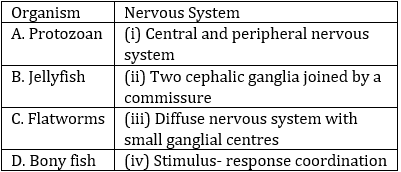
A. Protozoan → (iv) Stimulus–response coordination
Protozoans are unicellular organisms. They lack a nervous system but can still respond to stimuli through basic stimulus–response mechanisms (e.g., movement toward light or chemicals).
B. Jellyfish → (iii) Diffuse nervous system with small ganglial centres
Jellyfish (Phylum Cnidaria) have a nerve net — a diffuse network of neurons with no centralized brain. This is the simplest form of a nervous system.
C. Flatworms → (ii) Two cephalic ganglia joined by a commissure
Flatworms (Phylum Platyhelminthes) have a more developed nervous system than cnidarians. They show cephalization (concentration of nerve tissue in the head). Typically have two ganglia in the head region connected by a commissure (nerve bridge).
D. Bony fish → (i) Central and peripheral nervous system
Bony fish (Phylum Chordata) are vertebrates. They have a well-developed central nervous system (CNS) (brain and spinal cord) and peripheral nervous system (PNS).
So, the correct sequence is:
A–iv, B–iii, C–ii, D–i (Option b)