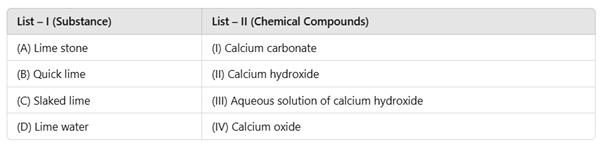
Correct option is C
Introduction:
- Oxidation state (or oxidation number) is defined as the hypothetical charge that an atom would have if all bonds to atoms of different elements were 100% ionic.
- It indicates the degree of oxidation or reduction of an element in a chemical compound. Determining oxidation states helps understand redox reactions, electron transfer, and chemical bonding.
Information Booster:
NH₃ and NO₂:
- In NH₃, oxidation state of N = –3 (since H is +1).
→ x + 3(+1) = 0 → x = –3 - In NO₂, oxidation state of N = +4.
→ x + 2(–2) = 0 → x = +4.
→ Different oxidation states (–3 and +4). - Represents extreme oxidation states of nitrogen (–3 and +4).
- Important in environmental chemistry ammonia (NH₃) is reduced, while nitrogen dioxide (NO₂) is oxidized and contributes to acid rain and photochemical smog.
- Oxidation state helps determine whether an atom has lost or gained electrons in a compound.
- Increase in oxidation number → Oxidation.
- Decrease in oxidation number → Reduction.
- Elemental form rule: Any element in its free or natural state (e.g., N₂, O₂, S₈, H₂) has an oxidation state of 0.
Additional knowledge:
- H₂S and S: Sulfur shows a change from –2 (in H₂S) to 0 (in S) when oxidized.
- This process occurs naturally in sulfur cycles and microbial oxidation.
- N₂ and S₈: Both are elemental forms; oxidation number = 0.
- These species are stable and not undergoing oxidation/reduction.
- HS⁻ and S²⁻: Both have S = –2, indicating no difference in oxidation state.
- Commonly found in anaerobic waterlogged soils and sediments.
 English
 10 Questions
 20 Marks
 12 Mins